
Module 1 · Language, Identity & Influence · Lesson 01
Voice, Identity & C2
What CPE rewards at C2 — and where your voice sits now
Get talking · Section 1
4 minWarm-up
Tell your partner one true sentence about your week — first in a text to a close friend, then in a meeting, then in an opening line of an opinion column. What had to change?
In one sentence each, describe a C2 speaker (a) to a sceptical friend, (b) to a Cambridge examiner. Where do the sentences diverge?
Which version of you most often shows up in English: the cautious one, the witty one, the diplomatic one, the blunt one? Defend your answer.
Grammar focus · Section 2
8 minStance, fronting and mild inversion
Quick rule
C2 candidates don't just say what's true; they signal how they hold it. Pair stance markers (arguably, ostensibly, by and large) with fronting (Rarely have I…, What strikes me is…) to control emphasis.
Examples
Rarely have I had a conversation that genuinely changed my mind — but that one did.
What strikes me about my own English is how much it depends on who I'm talking to.
Not until I moved abroad did I realise how much of my identity was tied up in language.
Ostensibly, I took CPE for the certificate; in reality, I wanted a sharper version of myself.
By and large, I'd say I come across as measured — though my closest friends would disagree.
Quick check
Question 1.Which sentence carries the most C2-typical emphasis?
Question 2.Pick the most natural C2 stance marker for: '___ , my opinion has shifted considerably.'
Question 3.Which is a clean fronting structure?
Question 4.'Not only ___ , but he refused to apologise afterwards.'
Build the sentence → spot the natural chunks → say it aloud → reply like a real conversation.
1.Reassemble a cleft self-description.
2.Reassemble a negative-adverbial inversion.
Quick check 1.Which is more C2: 'I think English changes who I am.' or 'What I find genuinely interesting is the way English seems to surface a different version of me.'?
Vocabulary · Section 3
6 minWords & phrases to own
to strike the right note
to find the appropriate tone or register for a situation
e.g. Her opening remarks struck exactly the right note — warm without being indulgent.
Use it now
Tell a partner about one moment recently when you struck — or failed to strike — the right note.
↻ Recycled in Speaking task & 180-word reflective paragraph
to read the room
to sense the mood or expectations of the people present and adjust accordingly
e.g. He just couldn't read the room — he kept joking long after everyone had stopped laughing.
Use it now
When did you most recently have to read the room? What did you change?
↻ Recycled in Listening discussion
measured (adj.)
careful, controlled, neither rushed nor emotional — positive connotation
e.g. Her response was measured — she neither apologised nor escalated.
Use it now
Compare 'measured' with 'cautious'. Which would you rather be called, and why?
↻ Recycled in Vocab pair work
self-effacing (adj.)
deliberately modest, downplaying one's own role or talent
e.g. Famously self-effacing, she insisted the credit belonged to her team.
Use it now
Is self-effacement a virtue at work? Defend your view in one sentence.
↻ Recycled in Conversation completion
to come across as / come over as
to give a particular impression — often unintentionally
e.g. In writing, I come across as much more formal than I actually am.
Use it now
How do you come across in English compared to your first language? Be specific.
↻ Recycled in Writing & Speaking
a marker of identity
a feature (accent, vocabulary, idiom) that signals where someone belongs
e.g. For her generation, slang was the clearest marker of identity.
Use it now
Name one marker of identity in your own English. What does it signal?
↻ Recycled in Reading follow-up
to hedge your bets
to keep your options open / avoid full commitment to one position
e.g. He hedged his bets, refusing to predict either outcome on the record.
Use it now
When is hedging your bets wise — and when is it just evasive?
↻ Recycled in Homework reflection
to nail one's colours to the mast
to declare one's position openly and irrevocably (idiom)
e.g. On climate policy she nailed her colours to the mast early and never wavered.
Use it now
What's one belief you'd genuinely nail your colours to the mast about?
↻ Recycled in Speaking P3 board
Tap an item on the left, then tap its match on the right.
Pair / group discussion
- Which expression best captures a version of you in English you'd actually like to project?
- Describe a public figure using three of today's items — without naming them. Can your partner guess?
Complete each stem about yourself
- Broadly speaking, in English I come across as…
- What I most struggle to strike the right note about in English is…
- On any honest reading, the version of me that shows up in meetings is…
Rank & justify
Rank these qualities from most to least 'you' in English. Justify each ranking with one stance marker and one specific example.
- measured
- self-effacing
- candid
- diplomatic
- wry
Quick write (60 seconds)
In two sentences, describe a moment when you failed to read the room in English. Use one fronting structure.
Pronunciation · Section 4
3 minSentence prominence on stance words
C2 speakers don't shout key words — they place the prominence on the stance markers. Listeners hear the evaluation, not just the fact.
- What STRIKES me is the way English surfaces a different version of me.
- Rarely HAVE I had a conversation that genuinely changed my mind.
- On any HONEST reading, the answer is not as clean as I'd like.
- Ostensibly, I'm here for the CERTificate; in REAlity, I want something sharper.
- I'd describe myself as MEAsured — though my closest friends would DISagree.
Reading · Section 5
8 minProficiency is a verb
Linguist & Society · Essay
Proficiency is a verb
Why fluency at C2 has less to do with the size of your vocabulary than with the agility of your register.
By H. Marsden · Quarterly essay
We speak of proficiency as if it were an inventory: a checklist of words mastered, tenses controlled, idioms acquired. By that logic, the most proficient speaker would simply be the one with the largest cache. Yet anyone who has spent any time around genuinely advanced second-language users knows this picture is, at best, misleading. The C2 speakers we recognise as such are rarely those with the showiest vocabulary; they are the ones with the lightest touch — the ones who can shift, almost imperceptibly, from a dry aside to a measured argument to a candid confession, often within a single turn.
What distinguishes proficiency at this level is not lexical bulk but register agility. It is the ability to read a room and recalibrate in real time: to soften where the moment requires deference, to sharpen where it invites disagreement, to retreat into self-effacement when assertion would land badly. The mistake many ambitious learners make — and many CPE candidates make in their first sitting — is to assume that more formal always means more advanced. It does not. Indiscriminate formality is its own kind of tin ear; it signals that the speaker has acquired the registers but not the judgement.
This matters because proficiency, in adult life, is rarely tested in monologue. It is tested in the quiet moments when a single phrase decides whether you sound thoughtful or evasive, generous or condescending, warm or merely polite. The CPE Speaking paper, for all its scripted choreography, is in fact a fairly close proxy for this: examiners reward not the candidate who has memorised the most idioms but the one who deploys the fewest, with the most precision, at exactly the right moment.
The useful reframing, then, is this. Proficiency is not a thing you accumulate; it is something you do, in real time, under pressure. It is a verb, not a noun. And the best preparation for the exam is also the best preparation for the rest of your life in English: not to learn more words, but to learn to hear, more finely, what each one actually does.
Question 1.What is the writer's central claim about proficiency at C2?
Question 2.What is the writer's attitude to candidates who default to formality?
Question 3.Which metaphor does the writer use to reframe proficiency?
Question 4.What rhetorical purpose does the final paragraph serve?
Q1.The writer believes the most proficient speakers are those with the largest vocabulary.
Q2.The text suggests that adult proficiency is rarely tested in extended monologue.
Q3.Indiscriminate formality is praised as a hallmark of C2 speakers.
Q4.The CPE Speaking paper is described as a reasonable proxy for real-world proficiency.
Listening · Section 6
8 minTwo multilingual speakers on identity and English
Listening audio
Tap play to listen. Scrub the bar or use ± 5 s to jump.
Show transcript
Noor:What strikes me, honestly, is that I'm not the same person in English as I am in Arabic. I'm more cautious. Drier, maybe.
Daniel:Mm — that's interesting, because I'd say I'm wittier in English than in Portuguese. It's like the second language gives me permission to try things out.
Noor:Permission's the right word. It's almost as if a second language is a slightly different costume — you behave differently because no one expects the old you.
Daniel:Although — and this is the bit I find genuinely hard — you can hide behind that. I've caught myself being vaguer in English than I'd ever be in Portuguese, just because I can.
Noor:Yes. Hedging your bets becomes a habit rather than a choice. Ostensibly polite; in reality, evasive.
Daniel:Which is, I suppose, exactly what an exam like CPE pushes against. It rewards you for committing — for nailing your colours to the mast, even when it's uncomfortable.
Noor:And for reading the room. The candidate who tries the same formal register on every prompt — that's the one who scores lower than they should.
Daniel:Whereas the one who shifts — wry one moment, measured the next, candid by the end — sounds like a person. Which is, presumably, the whole point.
Question 1.How does Noor describe her English-speaking self?
Question 2.What weakness do both speakers identify in their second-language behaviour?
Question 3.Why, in Daniel's view, does CPE reward register-shifting?
Visual stimulus · Section 7
3 minThe four CPE papers, re-read
30 seconds of silent looking. Then describe each paper in one sentence — using a stance marker.
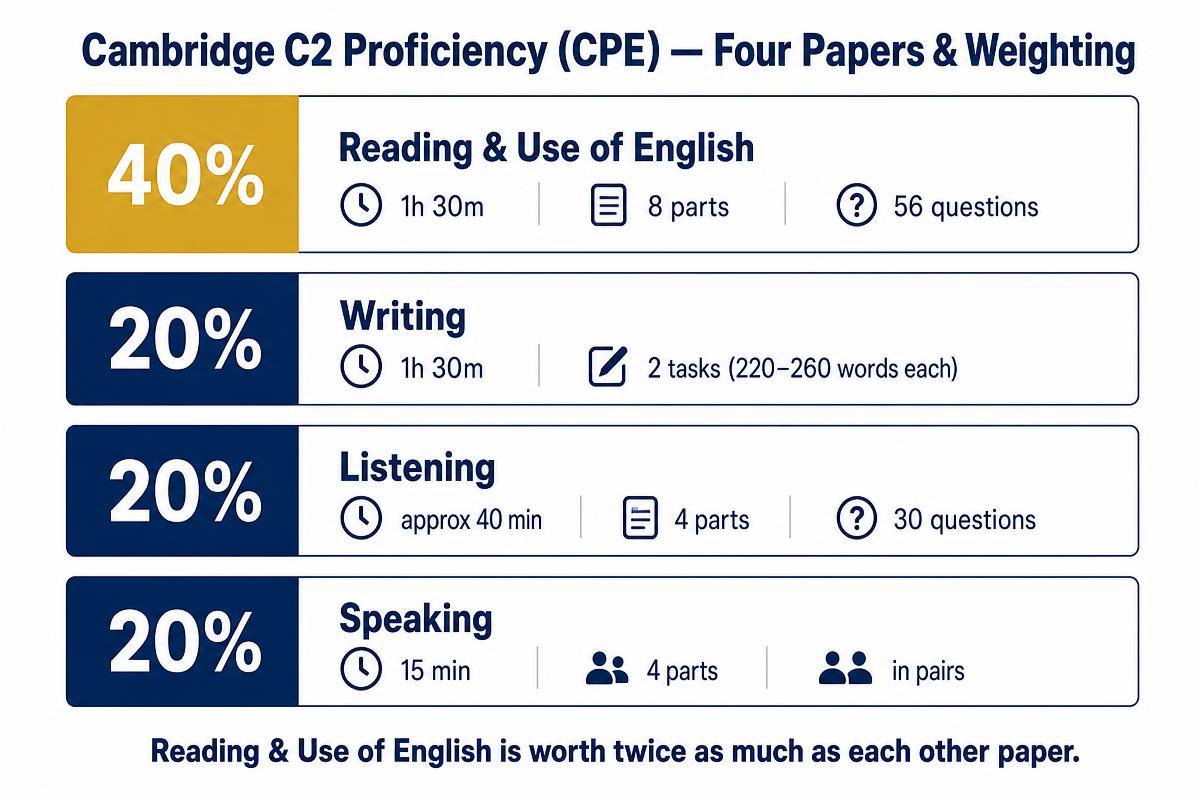
Discuss in pairs
Of the four papers, which one most demands the register-shifting Noor and Daniel describe? Which most rewards genuine stance? Justify both choices.
Exam skills · Section 8
3 minR&UoE Part 1 — Multiple Choice Cloze (shade of meaning)
Strategy
- 1.Read the entire passage for gist and register before touching a gap.
- 2.Predict the kind of word the gap wants — before reading the options.
- 3.Try each option aloud (in your head) inside the full sentence; the wrong collocation usually sounds wrong.
- 4.If two options survive, ask which carries the connotation the writer actually wants.
Example
'His remarks struck a ___ tone with the audience.' A) heavy B) measured C) thick D) wide. Answer: B — 'measured tone' is a fixed, positive-leaning collocation; the others either clash in register or fail collocationally.
Practice · Section 9
7 minFill in the blank
Question 1.Her response was admirably ___ — neither evasive nor inflammatory.
Question 2.He nailed his ___ to the mast on the issue from day one.
Question 3.Ostensibly polite, his email was, on any honest ___ , a refusal.
Question 4.She has an uncanny ability to ___ the room before she opens her mouth.
Question 5.Famously ___ , she insisted the prize belonged to her collaborators.
Question 6.What ___ me most about the exchange was how little either side conceded.
Q1.Complete with ONE word: 'On any ___ reading, the apology fell short.'
Q2.Complete with ONE word: 'Rarely ___ I encountered such a measured response.'
Writing · Section 10
4 minPut it in writing
Your task
Write a 180-word reflective paragraph: 'Who am I in English — and what does CPE actually want from that person?'
- • Open with a fronting structure or cleft.
- • Include at least two stance markers (arguably, ostensibly, on any honest reading, broadly speaking).
- • Include at least one item from today's connotation vocabulary (measured, self-effacing, strike the right note, read the room, hedge your bets, nail your colours to the mast).
- • End with a sentence that commits — no hedging in the final clause.
Before you submit
- ☐ Opening sentence uses a fronting structure (e.g. 'Rarely have I…', 'What strikes me is…') or a cleft ('It is X that…', 'What I notice is…') — not a plain subject-verb opener.
- ☐ At least two stance markers appear across the paragraph. Stance markers are short words or phrases that show how strongly you hold a view — e.g. 'arguably', 'ostensibly', 'broadly speaking', 'on any honest reading', 'to my mind'.
- ☐ At least one C2 item from today's vocabulary is used where its precise connotation fits — e.g. 'measured', 'self-effacing', 'strike the right note', 'read the room', 'hedge your bets', 'nail your colours to the mast'. Choose the item because it says exactly what you mean, not just because it sounds advanced.
- ☐ The final sentence commits to a clear position. No last-line hedge means no 'maybe', 'perhaps', 'it depends' or vague qualifier softening your conclusion.
- ☐ Total length is between 170 and 195 words — count before you submit.
Write your answer here
Restoring…0 words
Show model answer
What strikes me about my English self is that she is, on any honest reading, slightly more cautious than the rest of me. In Portuguese I'm wry, occasionally cutting; in English I default to measured, even when the moment invites edge. Ostensibly this is professionalism. In reality, it is a long-running habit of hedging my bets — softening every claim until it sounds, broadly speaking, like everyone else's. What CPE seems to want is precisely the opposite. The Speaking paper rewards the candidate who can read the room and shift register accordingly; the Writing paper rewards the one who can strike the right note for each genre without retreating into bland formality. The examiner is not, in the end, looking for politeness; she is looking for judgement. If the next eight weeks teach me anything, I want it to be this: how to nail my colours to the mast in English without losing the warmth that makes the rest of me, in any language, recognisable.
Speaking · Section 11
6 minMake it a real conversation
Pairs. 4 minutes each as examiner / candidate. The examiner asks three questions; the candidate answers each in a clearly different register — informal, neutral, then more academic. Listener notes one register shift, one stance marker and one connotation-precise item per round.
Speaking Part 3 mini-board — decide together, then justify to the class with one stance marker each.
Which version of you should CPE preparation try hardest to develop — the candid one, the diplomatic one, the academic one, or the witty one?
The candid version
Highest stakes in Speaking P3 and Writing essays — but easiest to mishandle.
The diplomatic version
Wins marks in collaborative tasks; risks blandness if overused.
The academic version
Essential for the formal Writing genres; can sound airless if not tempered.
The witty version
Unforgettable when it lands; catastrophic when it doesn't.
Useful phrases
- What strikes me is…
- On any honest reading,
- Ostensibly, … ; in reality, …
- Broadly speaking, I'd come across as…
- I'd describe myself as measured / self-effacing / candid, although…
- Rarely have I…
- I'm in two minds about it — but if pushed, I'd say…
- I'd nail my colours to the mast and say…
- ExaminerHow would you describe yourself in a professional setting?
- You_______________
- ExaminerHas English changed who you are?
- You_______________
Your speaking notes
Restoring…Optional · Teacher-led
Teacher Activities
Two optional extensions for a 75–90 min session, or fast-finisher work. ~18 min total
Homework · Section 12
Take-homeTake it home
Expand today's 180-word reflective paragraph into a 260-word piece. Add one concrete anecdote in which a register shift in English actually changed an outcome for you (a job, a friendship, a misunderstanding).
prompts · Use these as guiding questions
- Where were you, who else was there, what was at stake?
- What register did you start in, and what made you shift?
- What did the other person do differently because of the shift?
vocab list · Recycle at least five of these from today
- measured / self-effacing / candid
- strike the right note / read the room
- hedge your bets / nail your colours to the mast
- ostensibly / on any honest reading / broadly speaking
Record a 90-second voice note in three clearly different registers, on the same fact about yourself.
questions · Your prompt
- Pick one true thing about your work or study. Tell it three ways: (1) to a close friend in a voice note, (2) to a new colleague over coffee, (3) as the opening line of an opinion column. Same fact; three voices.
prompts · Self-listening checklist
- Did the lexis genuinely change across the three versions, or only the tone?
- Did I use at least one stance marker in version 3?
- Did I avoid recycling the same idioms across all three?
Write eight true-about-you sentences, one per item, that demonstrate connotation control.
vocab list · Eight C2 items from today
- measured
- self-effacing
- to strike the right note
- to read the room
- to hedge your bets
- to nail your colours to the mast
- ostensibly
- on any honest reading
prompts · Instructions
- Each sentence must be true about you, your work, or someone you know well.
- Each must show that you understand the connotation — positive, negative, or neutral.
- Bring them to the next lesson; you'll read three aloud and your partner will guess the connotation.
Finished? Reveal the answer key to self-check your work.
Recap · Section 13
Wrap-upWhat you've learned
- CPE at C2 rewards register agility — the lightest, most precise touch — not the biggest vocabulary.
- Stance markers (on any honest reading, ostensibly, broadly speaking) signal evaluation, not opinion.
- Fronting and mild inversion let you place emphasis where you want it — they're meaning, not ornament.
- Connotation, not dictionary meaning, decides R&UoE Part 1: choose by ear, not by gloss.
- Your CPE goal: sound less like a candidate and more like a person whose voice has been sharpened by the process.
Extra Practice
Need more practice with this exam skill?
R&UoE P1 · Multiple Choice Cloze
Part 1 · Multiple-choice cloze
Collocation, fixed phrases and shades of meaning
Practise this exam skill
Vocabulary · Collocation
Collocation & precision drill
Retrieval practice on the strong collocations CPE rewards
Practise this exam skill
Exam Strategy
Timing & decision-making drill
Applying technique under pressure across all four papers
Practise this exam skill
Optional — this doesn't count towards lesson completion.
Lesson complete
Sign in to save your progress across devices — we'll keep your local progress in the meantime.