
Module 2 · Grammar in Action · Lesson 05
Key Word Transformations
Patterns, paraphrase and precision
Get talking · Section 1
4 minWarm-up
In pairs: 'They made me wait an hour.' Rewrite it FIVE ways without changing the meaning. How many can you do in 60 seconds?
Which two are closest? a) 'I regret not calling her.' b) 'I wish I had called her.' c) 'If only I called her.' d) 'I should have called her.' Justify your pick.
What grammar does each word usually 'trigger'? SUGGESTED → ? UNLESS → ? HAD → ? WISHES → ? LIKELY → ?
Grammar focus · Section 2
8 minThe 12 transformation patterns (and how to spot them)
Quick rule
Don't translate — RECOGNISE the pattern. The given keyword is a signpost: it tells you which grammar family you're in.
Examples
Reporting: 'You should rest,' Tom said to me. → Tom ADVISED me TO REST. (advise sb to do)
Causative: Someone has stolen my bike. → I HAVE HAD MY BIKE STOLEN. (have something done)
Modal of deduction: It's possible she missed the train. → She MIGHT HAVE MISSED the train.
Wish: I regret not studying harder. → I WISH I HAD STUDIED harder. (wish + past perfect = past regret)
Comparative: I've never read a better book. → This is THE BEST BOOK I'VE ever read.
Cleft / inversion: As soon as we arrived, it rained. → NO SOONER HAD WE arrived than it rained.
Quick check
Question 1.Best transformation: 'They cleaned my suit yesterday.' Keyword: HAD
Question 2.'It is said that he stole the money.' Keyword: HAVE
Question 3.'I'm sure she didn't see us — she didn't wave.' Keyword: CAN'T
Question 4.'"Don't touch the wires," the engineer told us.' Keyword: WARNED
Question 5.Which answer BREAKS the rules?
Build the sentence → spot the natural chunks → say it aloud → reply like a real conversation.
1.Build a causative answer for 'Someone has stolen my bike.' (keyword: HAD)
2.Build a 'wish' past-regret answer. (keyword: WISHES)
3.Build a reporting answer for '"Why don't we go for a walk?"' (keyword: SUGGESTED)
Quick check 1.How many words (inclusive) must your answer contain in CPE Part 4?
Quick check 2.True or false: you may change the form of the given keyword if it sounds better.
Vocabulary · Section 3
6 minWords & phrases to own
have / get something done
causative — arrange for someone else to do something
Use it now
Say one sentence that is true about you using this expression.
be said / thought / believed to have done
impersonal passive reporting structure
Use it now
Say one sentence that is true about you using this expression.
no sooner… than / hardly… when
inversion meaning 'immediately after'
Use it now
Say one sentence that is true about you using this expression.
provided / providing that
conditional connector = 'only if'
Use it now
Say one sentence that is true about you using this expression.
unless
= 'if not'; triggers a positive verb after it
Use it now
Say one sentence that is true about you using this expression.
would rather (someone) did
preference about another person — past form, present meaning
Use it now
Say one sentence that is true about you using this expression.
it's (high) time (someone) did
criticism that something hasn't happened yet — past form, present meaning
Use it now
Say one sentence that is true about you using this expression.
regret + -ing / wish + past perfect
two ways to express past regret
Use it now
Say one sentence that is true about you using this expression.
Tap an item on the left, then tap its match on the right.
Pronunciation · Section 4
3 minStress signals paraphrase
When you say a transformed sentence aloud, the new keyword often takes contrastive stress because it's the bit that has shifted meaning. Training students to STRESS the keyword as they read each answer helps them feel whether the paraphrase still matches the original. If the stress feels wrong, the answer usually is.
- Original: 'I'm SURE she didn't see us.' → Paraphrase: 'She CAN'T have SEEN us.' (stress on CAN'T + SEEN)
- Original: 'They CLEANED my suit.' → Paraphrase: 'I HAD my suit CLEANED.' (stress on HAD + CLEANED)
- Original: 'It's POSSIBLE she missed the train.' → 'She MIGHT have MISSED the train.' (stress on MIGHT + MISSED)
- Original: 'I REGRET not calling.' → 'I WISH I had CALLED.' (stress on WISH + CALLED)
- Original: 'AS SOON AS we arrived, it rained.' → 'NO SOONER had we ARRIVED than it rained.' (stress on NO SOONER + ARRIVED)
Reading · Section 5
8 minWhy paraphrase is the real skill (a short note on Part 4)
Cambridge call this task 'Key Word Transformations', but a better name would be 'Controlled Paraphrase under Pressure'. The task gives you a sentence, a single capitalised keyword you cannot change, and a strict word limit of three to six words. Your job is to rewrite the missing chunk so that the new sentence means the same as the original, fits the gap and respects the keyword exactly as printed. What makes this hard is not vocabulary — most candidates know the words. What makes it hard is recognising the grammar family fast enough. CPE recycles a closed set of patterns: causative have/get, reported speech, modals of past deduction, wish / if only, comparative structures, conditional connectors (unless, provided that, otherwise), passive reporting (he is said to have…), inversion after negative adverbials (no sooner had I…), and a handful of fixed phrases with dependent prepositions. If you can name the family in five seconds — 'this is a causative', 'this is past deduction' — the answer almost writes itself. The expensive errors are predictable. Candidates change the keyword ('SUGGEST' becomes 'suggested'). They miss the word count. They paraphrase one half of the sentence and forget the meaning of the other half. They write a sentence that is grammatical but means something slightly different. None of these are listening problems or vocabulary problems. They are routine problems. A 60-second routine — read both sentences, name the pattern, draft, count words, verify meaning, check the keyword is untouched — fixes almost all of them. The deeper payoff is real: paraphrase is the editing skill you use every time you rewrite an email, summarise a meeting or quote a source in an essay. Train it on the page, and you'll use it for life.
Question 1.According to the writer, what is the MAIN difficulty in Part 4?
Question 2.Which of these is NOT a problem the writer warns about?
Question 3.What is the writer's preferred alternative name for the task?
Question 4.What is the real-world payoff of training this skill, according to the writer?
Q1.Part 4 tests an open set of unrelated puzzles with no recurring patterns.
Q2.The given keyword may be changed if a different form fits better.
Q3.A 60-second routine helps prevent the most common errors.
Q4.The skill of paraphrase has real-world uses beyond the exam.
Listening · Section 6
8 minParaphrase in spoken English — a study-skills dialogue
Listening audio
Tap play to listen. Scrub the bar or use ± 5 s to jump.
Show transcript
Tutor (f):OK, before we look at the next set, talk me through what you actually do when you see a Part 4 item. Step by step.
Sofia:I read the first sentence, then I look at the keyword, and I try to write something. Usually I write something and then count the words and it's seven, so I have to start again.
Tutor (f):Right. So your word-counting is happening at the end. I'd say it has to happen up front, almost before you write. You should be saying to yourself, 'I have three to six words, including the keyword' — count it on your fingers.
Marco:Can I ask — when the keyword is HAD, is it always a causative?
Tutor (f):Almost always, when the subject is the owner of the thing in the original. 'Someone stole my bike' → 'I had my bike stolen.' But HAD can also appear in past perfect inversions, like 'No sooner had I arrived…'. Look at the words around the gap before you commit.
Sofia:And what about SAID, BELIEVED, THOUGHT? Those confuse me.
Tutor (f):Those are almost always the impersonal passive reporting structure. 'People say he stole it' → 'He is said to have stolen it.' If you see one of those verbs plus TO in the gap, that family is your first guess every time.
Marco:So the trick is to name the family before I start writing.
Tutor (f):Exactly. Read, name the family — causative, deduction, wish, reporting, inversion — then draft. Then count. Then check the keyword hasn't quietly become a plural or a past tense. If you do that routine, you'll claw back two or three marks in this part alone.
Question 1.What problem does Sofia describe with her current approach?
Question 2.According to the tutor, what does the keyword HAD usually signal?
Question 3.What grammar family do SAID / BELIEVED / THOUGHT + TO usually point to?
Question 4.What routine does the tutor finally recommend?
Question 1.The tutor's overall message about Part 4 is best summarised as…
Visual stimulus · Section 7
3 minA real Part 4 page
30 seconds of silent scanning. Before you write anything, decide for EACH item: which grammar family is this?
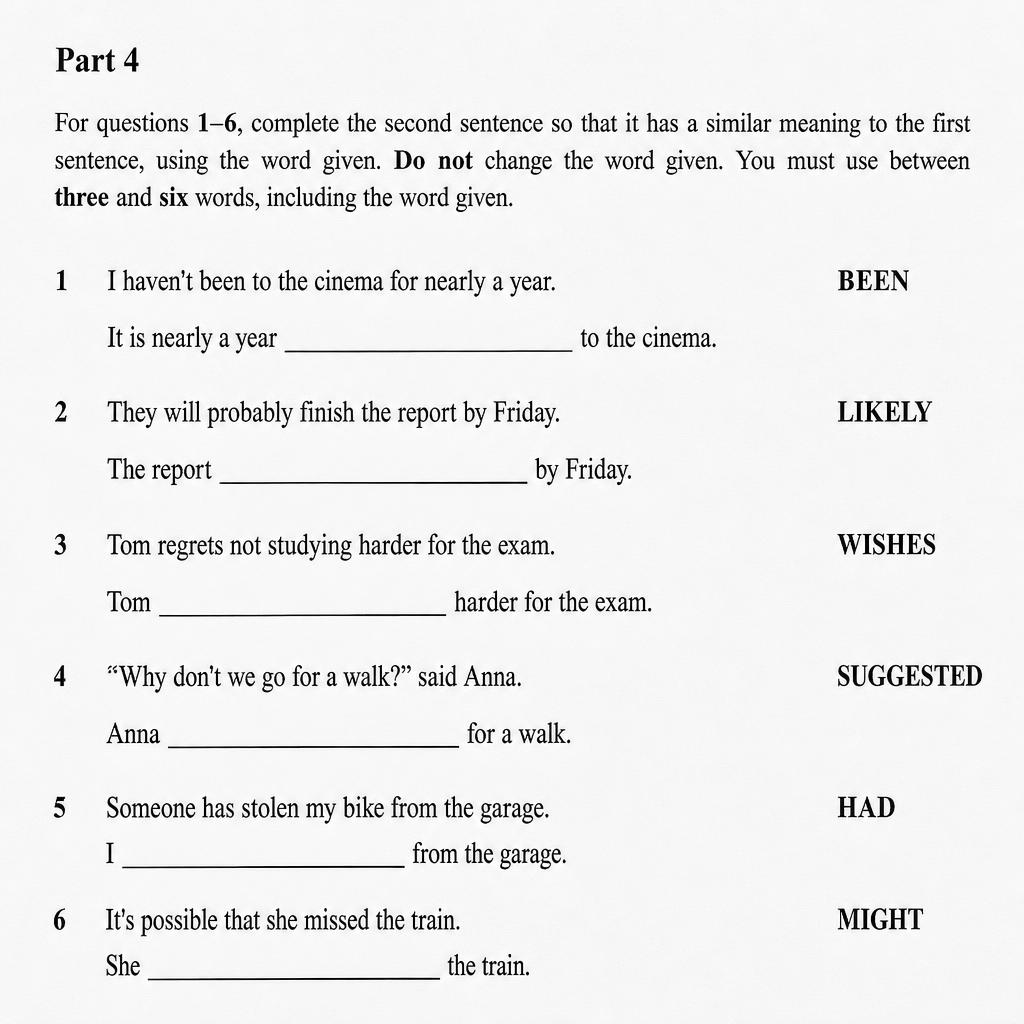
Discuss in pairs
In pairs, label each of the 6 items with a family: causative / reporting / wish / modal of deduction / impersonal passive / inversion. Then attempt the gaps.
Exam skills · Section 8
3 minR&UoE Part 4 — Key Word Transformations, in depth
Strategy
- 1.Read BOTH sentences first; underline the meaning that must survive.
- 2.Name the GRAMMAR FAMILY out loud: causative / reporting / wish / modal of deduction / passive / inversion.
- 3.Draft your answer; count the words on your fingers (3–6 INCLUDING the keyword).
- 4.Verify: same meaning? keyword UNCHANGED in form? grammar of the second sentence intact?
- 5.If two halves are possible, aim for the half you're most sure of — partial marks exist.
Example
'They will probably finish the report by Friday.' Keyword: LIKELY. Family = 'be likely to' + passive (because we don't keep 'they'). Draft: 'is likely to be finished'. Count: 5 words including LIKELY. Meaning: same. Keyword form: unchanged. Commit.
Practice · Section 9
7 minFill in the blank
Question 1.She wishes she ___ harder for the exam last year.
Question 2.I ___ my hair cut yesterday — it was getting too long.
Question 3.She is said ___ the painting from the gallery years ago.
Question 4.He ___ have missed the train — his car broke down on the way.
Question 5.No sooner ___ we sat down than the waiter brought the menu.
Question 6.Anna suggested ___ for a walk before dinner.
Question 7.Provided ___ on time, we'll catch the early train.
Question 8.It's high time you ___ a decision about the job offer.
Q1.Transform: 'They cleaned my car yesterday.' Keyword: HAD. Fill the gap (3–6 words including HAD): 'I ____________ yesterday.'
Q2.Transform: 'It's possible that she forgot.' Keyword: MIGHT. Fill the gap: 'She ____________.'
Q3.Transform: 'I regret not booking the flight.' Keyword: WISH. Fill the gap: 'I ____________ the flight.'
Q4.Transform: '"Don't open the door," she said.' Keyword: WARNED. Fill the gap: 'She ____________ the door.'
Writing · Section 10
4 minPut it in writing
Your task
Take any FIVE sentences from a recent email or message you wrote (English or translated). Rewrite each one TWICE: once using a reporting verb, once using a passive or causative. Aim for genuine paraphrase, not synonym swapping.
- • Show TWO transformations per original (10 sentences total).
- • Label each transformation with the family (reporting / passive / causative).
- • Don't change meaning. Don't pad with extra words.
Before you submit
- ☐ 10 transformations, all labelled.
- ☐ Each pair preserves the original meaning.
- ☐ At least one causative ('have something done') used.
- ☐ At least one impersonal passive ('is said to have…') used.
Write your answer here
Restoring…0 words
Show model answer
Original 1: 'I'll send the report by Friday.' Reporting: 'She PROMISED to send the report by Friday.' Passive: 'The report WILL BE SENT by Friday.' Original 2: 'Someone has fixed our heating.' Causative: 'We've HAD our heating FIXED.' Passive: 'Our heating HAS BEEN FIXED.' Original 3: 'It's possible he missed the email.' Modal: 'He MIGHT HAVE MISSED the email.' Reporting: 'She SUSPECTED that he had missed the email.'
Speaking · Section 11
6 minMake it a real conversation
Say-it-again pairs. In pairs, take turns: Student A reads one of the prompts aloud. Student B must rephrase it within 10 seconds using the keyword in brackets. Swap roles each round. Time: 6 minutes.
Useful phrases
- So you mean… (paraphrase)
- In other words…
- What you're saying is essentially…
- Another way of putting it…
- I'd rephrase that as…
- It might also be said that…
- To put it differently…
- That's the same as saying…
- A'Someone cleaned my office while I was on holiday.' (HAD)
- B_______________
- A'I'm sure she didn't see the email.' (CAN'T)
- B_______________
- A'"Why don't we postpone the meeting?" said Tom.' (SUGGESTED)
- B_______________
Your speaking notes
Restoring…Optional · Teacher-led
Teacher Activities
Two extensions for stronger groups or longer sessions. ~22 min total
Homework · Section 12
Take-homeTake it home
Complete EIGHT mixed key-word transformations. For each one, name the grammar family in brackets before writing the answer.
questions · Eight items (write the gap only, 3–6 words including the keyword)
- 1. They will deliver the parcel tomorrow morning. (DELIVERED) — The parcel ____________ tomorrow morning.
- 2. I'm sure he didn't lock the door. (CAN'T) — He ____________ the door.
- 3. 'Don't swim here,' the lifeguard said. (WARNED) — The lifeguard ____________ there.
- 4. Someone has repaired my watch. (HAD) — I ____________.
- 5. People believe she invented the device. (HAVE) — She is believed ____________ the device.
- 6. I regret telling him the secret. (WISH) — I ____________ him the secret.
- 7. As soon as the film started, the lights went out. (SOONER) — No ____________ than the lights went out.
- 8. It's possible we took the wrong turning. (MIGHT) — We ____________ the wrong turning.
Finished? Reveal the answer key to self-check your work.
Build a one-page 'KWT family map'. For each of the SIX families, write the trigger keywords you'd expect to see and ONE model transformation.
vocab list · Six families to cover
- Causative (have/get something done)
- Modal of past deduction (must/might/can't have + p.p.)
- Reporting verbs (suggest/admit/advise/warn…)
- Wish / If only / It's high time
- Impersonal passive (is said/believed/thought to have…)
- Inversion after negative adverbials (no sooner, hardly, not only, never)
prompts · For each family
- List 3 trigger keywords that usually signal it.
- Write ONE model transformation you can recall from memory.
- Mark the family you find HARDEST — that's tomorrow's first drill.
Finished? Reveal the answer key to self-check your work.
Write a 100–120 word study journal entry: 'The transformation family I find easiest, and the one I find hardest — and why.' Use at least THREE technical labels from this lesson (e.g. causative, impersonal passive, inversion).
prompts · Include
- One named family you find easy + the trigger keyword that makes it easy for you.
- One named family you find hard + the exact error you keep making.
- One concrete plan for next week's revision.
Record yourself (60–90 seconds) explaining ONE transformation family to an imaginary classmate as if you were the teacher. Name the family, give the trigger keywords, model one example aloud, and warn about the most common mistake.
prompts · Cover, in this order
- Name the family.
- Give 2–3 trigger keywords.
- Say one full model transformation aloud.
- Warn about the most common error (e.g. changing the keyword).
Recap · Section 13
Wrap-upWhat you've learned
- Part 4 = six items, 1 mark per half (max 12), 3–6 words INCLUDING the keyword, keyword UNCHANGED.
- It's a closed set of grammar families — name the family before you write the words.
- Routine: read both → name family → draft → count words → verify meaning + keyword form.
- Most common errors are routine errors (keyword changed, word count wrong), not knowledge errors.
- Train paraphrase as a real-world editing skill, not as exam trivia.
Extra Practice
Need more practice with this exam skill?
R&UoE P1 · Multiple Choice Cloze
Part 1 · Multiple-choice cloze
Collocation, fixed phrases and shades of meaning
Practise this exam skill
Reading P5 · Multiple Choice
Part 5 · Multiple choice on a short text
Attitude, implication and reference — beyond literal meaning
Practise this exam skill
Vocabulary · Collocation
Collocation & precision drill
Retrieval practice on the strong collocations CPE rewards
Practise this exam skill
Optional — this doesn't count towards lesson completion.