
Module 1 · Language, Identity & Influence · Lesson 04
Reading Between the Lines
Listening Part 1 — attitude, tone and implication
Get talking · Section 1
4 minWarm-up
Read aloud — three times, three meanings: 'Oh, that's interesting.' (genuine / sarcastic / polite-but-bored). What changes? Words? Tone? Both?
Which speaker is more committed? A: 'It's a disaster.' B: 'It's not exactly been a triumph, has it?' What does B's hedge tell you about how they feel?
In 60 seconds, list every word/phrase you know to describe how someone FEELS about something: e.g. enthusiastic, sceptical, lukewarm, in two minds…
Grammar focus · Section 2
8 minHedges, intensifiers and modals of attitude
Quick rule
Attitude is rarely stated — it's hedged, intensified or buried in a modal. 'I suppose it's fine' ≠ 'It's absolutely fine.'
Examples
I'd say it's been more rewarding than I expected — though I'm not getting carried away.
It's not exactly the breakthrough we were hoping for, is it?
You'd have thought a project this size would be straightforward — turns out, not so much.
I'm genuinely enthusiastic, but I do have one or two reservations.
I suppose it's fine — it's just not what I had in mind.
Quick check
Question 1.'I suppose it's fine.' — what attitude does the speaker most likely signal?
Question 2.'You'd have thought a project this size would be straightforward.' — the speaker probably means…
Question 3.Which sentence is the LEAST committed?
Question 4.'I'm genuinely enthusiastic, but I do have one or two reservations.' — the overall attitude is…
Build the sentence → spot the natural chunks → say it aloud → reply like a real conversation.
1.Build a hedged-positive opinion.
2.Build an attitude sentence using 'not exactly'.
Quick check 1.True or false: in Listening Part 1, the correct answer is usually a near-paraphrase of what the speaker says, not the exact wording.
Vocabulary · Section 3
6 minWords & phrases to own
enthusiastic about
openly positive and energetic about something
Use it now
Say one sentence that is true about you using this expression.
lukewarm about
showing little enthusiasm; not really for or against
Use it now
Say one sentence that is true about you using this expression.
in two minds about
unable to decide; genuinely undecided
Use it now
Say one sentence that is true about you using this expression.
broadly in favour of
generally supportive, with some reservations
Use it now
Say one sentence that is true about you using this expression.
sceptical about / of
doubtful; not convinced something is true or will work
Use it now
Say one sentence that is true about you using this expression.
have reservations about
to feel partly unsure; to disagree on some points
Use it now
Say one sentence that is true about you using this expression.
be taken aback by
to be surprised — often unpleasantly — by something
Use it now
Say one sentence that is true about you using this expression.
be quietly confident
to feel sure something will succeed, without showing off
Use it now
Say one sentence that is true about you using this expression.
Tap an item on the left, then tap its match on the right.
Pronunciation · Section 4
3 minIntonation = attitude
At C1, intonation is the single biggest carrier of attitude. A rising tail on 'I suppose so↗' signals doubt; a falling 'I suppose so↘' sounds resigned; a flat 'I suppose so.' sounds bored. Drill the same words with different intonation contours until students can hear — not just read — the attitude.
- 'It's been INteresting.' — genuine vs. polite-but-bored: shift the stress from INteresting to interESTing and notice the change.
- 'I'm broadly in FAvour…' (slight rising tail → 'but is coming').
- 'You'd have THOUGHT it would be straightforward.' (high pitch on THOUGHT signals 'and it wasn't').
- 'I'm QUIETly CONfident.' (low, even pitch — calm certainty, not excitement).
- 'I was QUITE taken aBACK.' (jump in pitch on aBACK = real surprise).
Reading · Section 5
8 minHow attitude leaks into language (a short note on inference)
Ask a fluent English speaker how they feel about something and, more often than not, they will not tell you directly. They will hedge ('I suppose'), they will qualify ('on the whole'), they will intensify selectively ('I'm genuinely…'), and they will leave the real attitude to leak out of the gaps. To a learner, this can feel maddening. To a Listening Part 1 examiner, it is the entire point. The three short extracts in Part 1 are designed so that the surface words rarely give you the answer. A speaker might say, perfectly cheerfully, 'It's been a fascinating project,' and then add, almost as an afterthought, 'though I'd be lying if I said I'd do it again.' The cheerful adjective is a decoy. The afterthought is the answer. Candidates who chase the loudest word — fascinating — pick the wrong option. Candidates who notice the quiet qualifier — though I'd be lying… — pick the right one. This is why attitudinal vocabulary matters so much at C2. If you do not have 'lukewarm', 'in two minds', 'broadly in favour' and 'rather sceptical' in your active range, you cannot recognise them when an examiner paraphrases them on the page. The options will look interchangeable. They are not. The fix is unglamorous but reliable: read every Part 1 question stem before you listen, predict the kind of attitude word that would answer it, and then listen for hedges and qualifications, not just facts.
Question 1.What is the writer's main point about how attitude is usually expressed?
Question 2.What metaphor does the writer use for the cheerful adjective in the example?
Question 3.According to the writer, why do candidates choose the wrong option?
Question 4.What practical fix does the writer recommend?
Q1.The writer says C1 listeners can rely mainly on facts, not attitude.
Q2.An afterthought ('though I'd be lying…') can carry the real attitude.
Q3.Attitudinal vocabulary is not important for Listening Part 1.
Q4.Reading the question stems before listening is recommended.
Listening · Section 6
8 minListening Part 1 — three short extracts (≈1 minute each)
Notes
Pre-listening briefing — what each extract is about
- ▸Extract 1 — Project manager updating her team. Focus: how she feels about progress.
- ▸Extract 2 — Radio interview with a young author. Focus: her reaction to her book's reception.
- ▸Extract 3 — Two colleagues discussing a new booking system. Focus: their attitude to the change.
- ▸Read both question stems for each extract BEFORE you hear it. Predict the attitude word in the answer.
Listening audio
Tap play to listen. Scrub the bar or use ± 5 s to jump.
Show transcript
Narrator (f):Extract One. You hear a project manager giving an update to a team.
Anna:So — where are we, honestly? On paper, we're roughly where we said we'd be. We've cleared the first two phases and the client is, broadly speaking, happy. That said, I'd be lying if I told you I'm completely relaxed about the timeline. The next phase is far bigger than people realise, and frankly, I think we've underestimated it.
Anna:What I'd suggest is that, before we commit to the next sprint, we sit down and rebuild the schedule together. Not because I want a redesign — I don't — but because, the way it stands, we're depending on feedback that hasn't arrived. So let's not pretend it has.
Narrator (f):Extract Two. You hear part of a radio interview with a young author.
Interviewer (f):Maya, your novel has had a very loud reception. Did you set out to write something this provocative?
Maya:Honestly, no. I started writing about my own family — small, quiet things — and then last year I saw a story in the news that reframed everything I'd been writing about. I wouldn't say it changed the plot exactly, but it sharpened the edges. I think that's what people are responding to.
Interviewer (f):And the reaction itself — have you been pleased?
Maya:I was taken aback, to be honest. I expected a small, kind response. What I got was a very loud, very divided one. I'm not complaining — readers care, and that's a gift. But I won't pretend it hasn't made me think differently about what I'd publish next.
Narrator (f):Extract Three. You hear a conversation between two colleagues at work.
Elena:Have you actually used the new booking system yet? Because I tried it on Monday and I'm, well, I'm a bit lost.
Tom:I have, and I'd say it's… fine? It's not exactly intuitive. I think the problem is they rolled it out without really telling anyone how it differs from the old one.
Elena:That's the thing. I'm not against the change in principle — I'm just sceptical we're ready for it. We're already two people short this quarter.
Tom:Look, why don't we get the whole team in a room for fifteen minutes on Thursday and just walk through it together? Better than each of us guessing in private.
Question 1.Extract One · How does Anna feel about the progress made so far?
Question 2.Extract One · What does Anna want to do about the next sprint?
Question 3.Extract Two · Why did Maya write the book in the way she did?
Question 4.Extract Two · What is Maya's attitude to the reaction?
Question 5.Extract Three · What is Elena's main concern?
Question 6.Extract Three · What does Tom suggest?
Question 1.Maya says: 'I'm not complaining — readers care, and that's a gift. But I won't pretend it hasn't made me think differently about what I'd publish next.' Her overall attitude is best described as…
Visual stimulus · Section 7
3 minA real Listening Part 1 page
30 seconds of silent scanning — this is what you'll see on the day, BEFORE you hear anything.
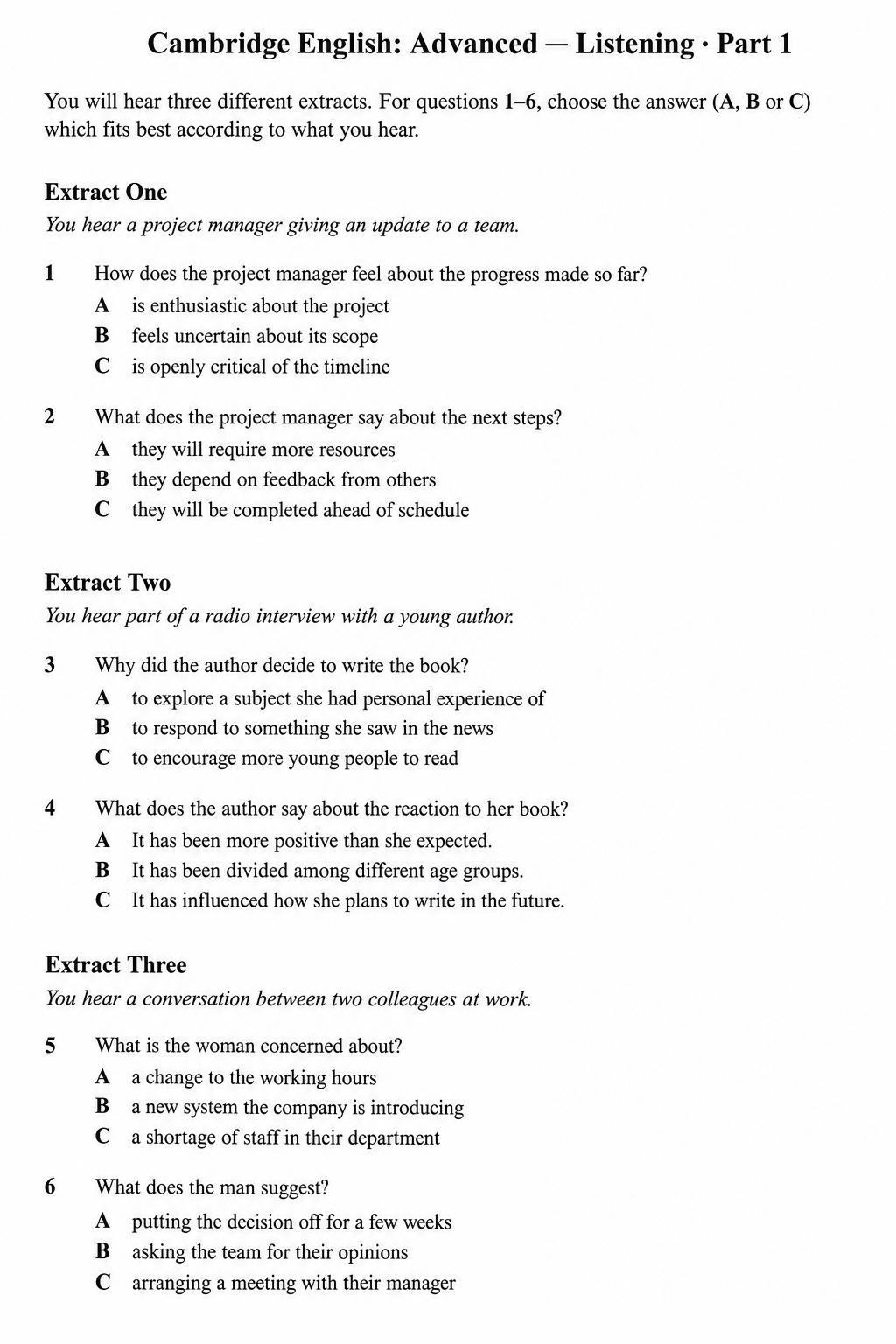
Discuss in pairs
In pairs, predict for each question: what kind of attitude word would the correct option contain? Then check against the listening.
Exam skills · Section 8
3 minListening Part 1 — three short extracts, in depth
Strategy
- 1.Use the pause to read BOTH question stems for the next extract.
- 2.Predict the kind of attitude word the answer will contain (positive? hedged? critical?).
- 3.On first listen — answer in pencil. On second listen — confirm by finding the EXACT hedge / qualifier.
- 4.Beware the decoy: the loudest adjective is often a trap.
- 5.If two options look similar, choose the one whose feeling matches the speaker's hedges.
Example
Q: 'How does the project manager feel about the progress?' Speaker: 'On paper, we're roughly where we said we'd be… that said, I'd be lying if I told you I'm completely relaxed about the timeline.' The hedge 'I'd be lying if I told you I'm completely relaxed' = worried. Answer: broadly satisfied but worried about the next phase.
Practice · Section 9
7 minFill in the blank
Question 1.She's ___ enthusiastic about the new role, but she does have one or two reservations.
Question 2.I'm ___ in two minds about it, to be honest — I can see both sides.
Question 3.He was ___ taken aback by the size of the response to his article.
Question 4.I'm ___ in favour of the proposal, but I'd like to see the figures first.
Question 5.She remained ___ confident throughout, even when results were slow to come in.
Question 6.Frankly, I'm rather ___ about whether this approach will work in practice.
Question 7.The reception has been ___ — some readers loved it, others were uneasy.
Question 8.I wouldn't say I'm disappointed — more, well, a bit ___ on the whole idea.
Q1.Listening paraphrase. Speaker says: 'I'd be lying if I told you I'm completely relaxed about the timeline.' Choose ONE word that describes the speaker's attitude.
Q2.Listening paraphrase. Speaker says: 'I'm just sceptical we're ready for it.' This means the speaker has serious ___.
Q3.Open Cloze (one word): 'She was taken ___ by the strength of the reaction to her book.'
Writing · Section 10
4 minPut it in writing
Your task
Write a 90–110 word internal note from Tom (Extract Three) to his manager. Capture his MIXED attitude — co-operative but cautious — using at least FOUR attitudinal expressions from this lesson.
- • Audience: Tom's manager. Tone: professional, hedged, honest.
- • Must mention: the new booking system, the team's readiness, the proposed Thursday walk-through.
- • Aim for hedged-positive, not openly critical.
Before you submit
- ☐ Used ≥4 attitudinal expressions (e.g. broadly in favour, not exactly, quietly confident, have reservations).
- ☐ Showed mixed — not flat — attitude.
- ☐ No openly negative wording.
- ☐ Word count 90–110.
Write your answer here
Restoring…0 words
Show model answer
Hi Sara — a quick note on the new booking system. Broadly speaking, the team is in favour of the change, and I'm quietly confident we'll get there. That said, I'd be lying if I said the rollout has been entirely smooth: the interface isn't exactly intuitive, and several of us still have reservations about timing — we're two people short this quarter, so we're sceptical we can absorb a learning curve right now. To take the heat out of that, Elena and I have suggested a fifteen-minute team walk-through on Thursday. I'll send a calendar invite this afternoon, if that works for you. — Tom
Speaking · Section 11
6 minMake it a real conversation
Speaking Part 1 attitude lab. In threes, take it in turns to be the examiner. Ask each other the three questions below and FORCE a hedged answer — no flat 'yes' or 'no'. Time: 3 minutes per learner.
Speaking Part 3 — pick TWO attitudes that are hardest to detect in fast Listening Part 1 extracts.
Which attitudes are hardest to hear at C2?
Quietly sceptical
Hedged, never said outright.
Appreciative but cautious
Positive surface, careful underneath.
Politely frustrated
Diplomacy masks the real feeling.
Genuinely enthusiastic
Easy to confuse with rehearsed praise.
Useful phrases
- I'd say I'm broadly in favour, although…
- Honestly, I'm in two minds about it.
- I'm quietly confident that…
- I won't pretend I wasn't a bit taken aback by…
- I'm rather sceptical, to be honest.
- It's been more rewarding than I expected — though I'm not getting carried away.
- I'd be lying if I said…
- It's not exactly… but it's not bad either.
- AHave you been enjoying your new course? (target attitude: positive but qualified)
- B_______________
- AAnd how do you feel about the move to remote learning? (target attitude: undecided)
- B_______________
- AWould you recommend the course to a friend? (target attitude: cautiously positive)
- B_______________
Your speaking notes
Restoring…Optional · Teacher-led
Teacher Activities
Two extensions for stronger groups or longer sessions. ~22 min total
Homework · Section 12
Take-homeTake it home
Re-read the three extract transcripts. For EACH extract, find the single sentence that most strongly carries the speaker's attitude and explain why in one line.
audio script · Extracts 1–3 (excerpts)
EXTRACT 1 — Anna: 'On paper, we're roughly where we said we'd be. We've cleared the first two phases and the client is, broadly speaking, happy. That said, I'd be lying if I told you I'm completely relaxed about the timeline. The next phase is far bigger than people realise, and frankly, I think we've underestimated it.' EXTRACT 2 — Maya: 'I was taken aback, to be honest. I expected a small, kind response. What I got was a very loud, very divided one. I'm not complaining — readers care, and that's a gift. But I won't pretend it hasn't made me think differently about what I'd publish next.' EXTRACT 3 — Elena: 'I'm not against the change in principle — I'm just sceptical we're ready for it. We're already two people short this quarter.'
prompts · For each extract, write:
- 1 sentence that carries the attitude (quote it).
- 1 line: which words specifically signal the attitude (the hedge / qualifier).
- 1 line: paraphrase the attitude in plain English.
Finished? Reveal the answer key to self-check your work.
Build an attitude vocabulary page. Under each heading, list ≥5 expressions and write one personal example sentence using each.
vocab list · Three headings
- Clearly positive (e.g. genuinely enthusiastic, thoroughly enjoyed, quietly confident)
- Mixed / hedged (e.g. broadly in favour, in two minds, has its moments)
- Clearly negative (e.g. deeply sceptical, frankly disappointed, not exactly thrilled)
prompts · For each expression
- Write one full personal example sentence — about your life, not a generic 'people say…'
- Mark any you actually heard yourself produce this week.
Finished? Reveal the answer key to self-check your work.
Write a 100–120 word email to a friend in which you describe your attitude towards ONE of: your current job/course, social media, AI tools at work. Use at least FOUR attitudinal expressions from today.
vocab list · Recycle ≥4 of these
- broadly in favour of
- in two minds about
- rather sceptical
- quietly confident
- taken aback by
- thoroughly enjoyed
- I'd be lying if I said
- not exactly
Record yourself (60–90 seconds) answering: 'How do you feel about the last big change in your work or studies?' Use at least THREE attitudinal expressions and one hedged opinion.
prompts · Before you record
- Plan: what's the BIG attitude (positive / mixed / negative)?
- Choose 3 attitudinal expressions you'll force yourself to use.
- Decide where you'll HEDGE (e.g. 'broadly… that said…').
- Record once; listen back; re-record once more.
Recap · Section 13
Wrap-upWhat you've learned
- Listening Part 1 = three short extracts, each with TWO MCQs — heard TWICE.
- Most questions are attitude / feeling / purpose, NOT facts.
- Read the stems FIRST, predict the attitude word, then listen for the hedge.
- The loudest adjective is often a decoy; the quiet qualifier is usually the answer.
- Active attitudinal lexis (broadly, in two minds, sceptical, lukewarm, taken aback) is non-negotiable at C2.
Extra Practice
Need more practice with this exam skill?
Optional — this doesn't count towards lesson completion.