
Module 1 · Language, Identity & Influence · Lesson 03
Lexical Precision
R&UoE Part 1 — connotation, collocation and shade
Get talking · Section 1
4 minWarm-up
Which sound natural with 'rain': heavy / strong / big / large? What does this tell us?
Complete: 'a ___ contribution / a ___ effect / a ___ chance' with significant / profound / slim. Same family — very different jobs.
Brainstorm five collocations with 'decision'. Which would a B2 learner not produce naturally?
Grammar focus · Section 2
8 minDependent prepositions and verb–noun collocations
Quick rule
Part 1 leans on two patterns: dependent prepositions (depend ON, increase IN) and verb–noun pairs (do research, make a decision, take responsibility).
Examples
She's highly capable OF handling the project on her own.
There's been a marked increase IN demand for sustainable products.
He made a deliberate decision to step down.
We need to do further research before we commit to anything.
The proposal is broadly in line WITH our existing strategy.
Quick check
Question 1.'The decision was largely ___ line with company policy.'
Question 2.'She ___ a real effort to listen to the team.'
Question 3.'We need to ___ more research before we commit.'
Question 4.'There's been a significant increase ___ enquiries this quarter.'
Build the sentence → spot the natural chunks → say it aloud → reply like a real conversation.
1.Build a sentence using a verb–noun collocation.
2.Build a sentence using a dependent preposition.
Quick check 1.True or false: in Multiple Choice Cloze, all four options usually mean roughly the same — the test is which one fits the collocation.
Vocabulary · Section 3
6 minWords & phrases to own
make a contribution to
to give something useful (ideas, money, effort) to a project / group
Use it now
Say one sentence that is true about you using this expression.
draw a conclusion
to reach a logical decision based on evidence
Use it now
Say one sentence that is true about you using this expression.
raise an objection
to formally state that you disagree with something
Use it now
Say one sentence that is true about you using this expression.
have a profound effect on
to influence deeply and lastingly
Use it now
Say one sentence that is true about you using this expression.
to be widely regarded as
to be considered, by many people, to be (something)
Use it now
Say one sentence that is true about you using this expression.
broadly speaking
in general terms (a Part 1 favourite)
Use it now
Say one sentence that is true about you using this expression.
a marked improvement / increase
a clear, noticeable improvement / increase (formal)
Use it now
Say one sentence that is true about you using this expression.
to take steps to (do)
to take deliberate action towards a goal
Use it now
Say one sentence that is true about you using this expression.
Tap an item on the left, then tap its match on the right.
Pronunciation · Section 4
3 minStress in noun phrases vs. verb phrases
In a noun phrase, the noun usually carries main stress ('a profound EFFECT'); in a verb phrase, the verb often does ('to DRAW a conclusion'). Drilling this makes collocations sound idiomatic.
- a proFOUND EFFECT — 'It had a profound effect on me.'
- a SIGnificant contriBUtion — 'She made a significant contribution.'
- to DRAW a concLUsion — 'It's too early to draw a conclusion.'
- to TAKE responsiBIlity — 'He's willing to take full responsibility.'
- a MARKED imPROVEment — 'There's been a marked improvement this term.'
Reading · Section 5
8 minWhy the dictionary won't save you (a short note on collocation)
If you look up 'heavy' in a learner's dictionary, you'll find a confident, helpful definition: of great weight; difficult to lift. None of that, however, will tell you why English speakers say 'heavy rain' and 'heavy traffic' but not 'heavy wind' or 'heavy temperature'. The dictionary defines words; it does not — at least not visibly — describe their social lives. This is the territory of collocation: the company words keep. Some collocations are nearly fixed: you do research, you make a decision, you take responsibility. Others sit on a sliding scale of acceptability: 'a marked improvement' sounds natural and faintly formal; 'a noticeable improvement' is also fine; 'a big improvement' is acceptable but plainer; 'a strong improvement' is wrong, although a learner could be forgiven for trying it. For a C1 candidate, the implication is unsentimental. Vocabulary knowledge is no longer measured by how many words you can define. It is measured by how reliably you produce the right combinations under pressure. This is why Multiple Choice Cloze tasks rarely turn on dramatic differences in meaning — all four options usually mean roughly the same thing — and almost always turn on collocational fit. The test is not 'what does this word mean?' but 'which of these words actually lives with the words around it?'. The good news is that collocations can be learned, just slowly and in pairs. Reading widely helps. Noticing rather than guessing helps more. And, irritatingly for the impatient student, time helps most of all.
Question 1.What is the writer's main point about dictionaries?
Question 2.Which phrase does the writer use for collocation?
Question 3.How does the writer describe 'a strong improvement'?
Question 4.According to the writer, what shifts at C2 in how vocabulary knowledge is measured?
Q1.The writer thinks 'heavy temperature' is a natural collocation in English.
Q2.Multiple Choice Cloze tasks usually turn on huge differences in meaning between options.
Q3.Reading widely is described as helpful for learning collocations.
Q4.The writer suggests time is the most important factor in learning collocations.
Listening · Section 6
8 minA language teacher coaches a CPE student through one MCC gap
Listening audio
Tap play to listen. Scrub the bar or use ± 5 s to jump.
Show transcript
Sarah:OK, walk me through gap three. What did you pick?
Diego:I picked 'big'. The sentence was 'It had a ___ effect on the way we work.' I thought 'big effect' sounds fine.
Sarah:It's not wrong exactly — but it's not what the test wants. What were the four options?
Diego:Big, profound, large, wide.
Sarah:Right. So which one actually lives with 'effect' in writing at this level?
Diego:Hmm. 'A profound effect' — yes, I've definitely seen that.
Sarah:More often than not, that's the trap in Part 1. All four options mean roughly the same. The question is collocational fit, not meaning.
Diego:So my strategy of picking the one I understand isn't quite enough.
Sarah:Exactly. Quick test: would a journalist or an academic write this combination? If yes, it's probably the answer. If it sounds like something you'd say at lunch, it probably isn't.
Diego:OK. So gap three is 'profound'. That feels right now I say it out loud.
Question 1.What is Diego's original choice for the gap?
Question 2.What does Sarah say is the real test in Part 1?
Question 3.Which informal test does Sarah suggest?
Visual stimulus · Section 7
3 minA real Multiple Choice Cloze page
30 seconds of silent scanning — this is what you'll see on the day.
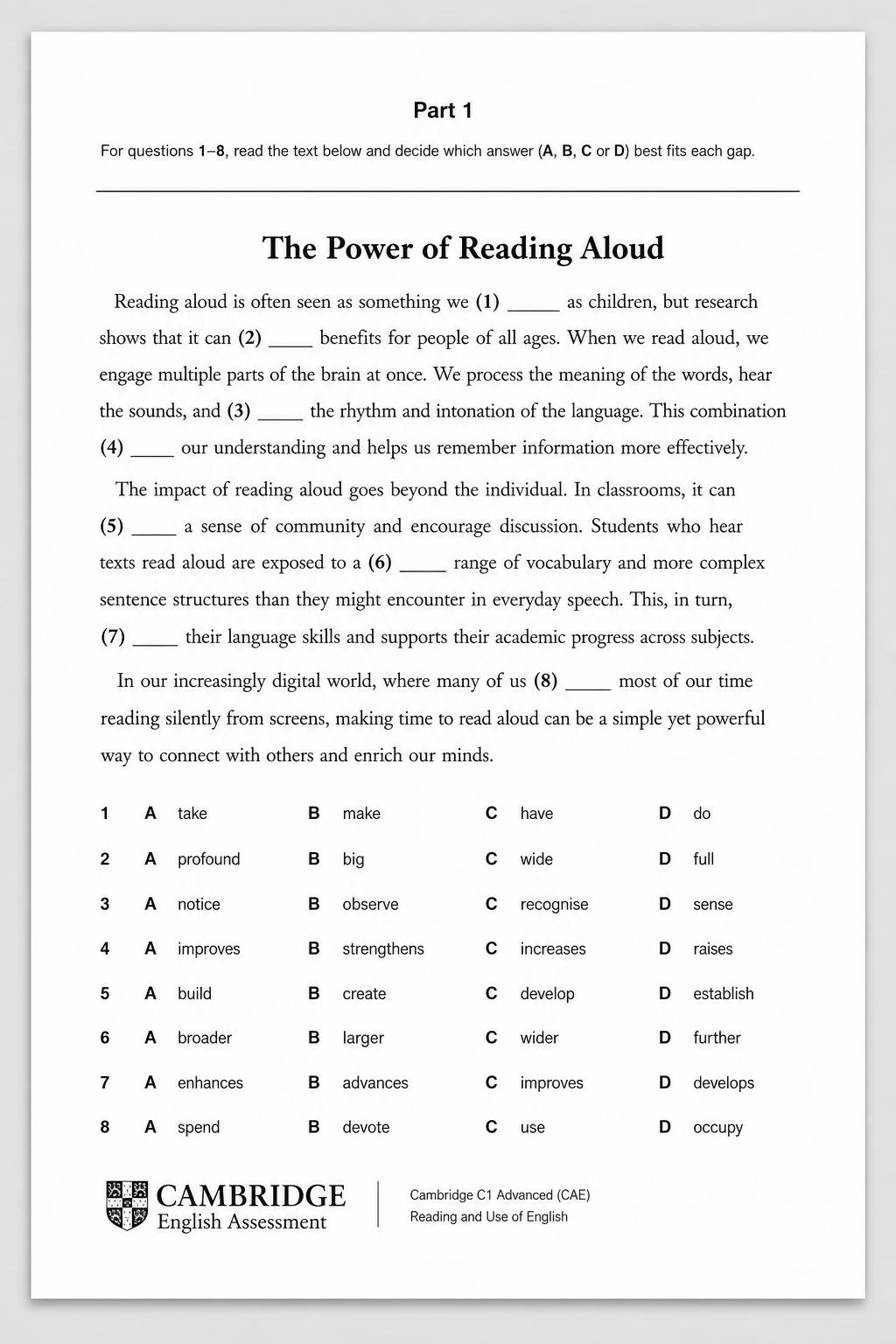
Discuss in pairs
In pairs, predict the answer for gap 1 BEFORE arguing. Then check against the strategy below.
Exam skills · Section 8
3 minR&UoE Part 1 — Multiple Choice Cloze, in depth
Strategy
- 1.Read the whole text once for gist — don't touch any gap.
- 2.For each gap, identify the part of speech and predict a word.
- 3.Test each option in the full sentence — listen for the collocation.
- 4.Ask: would a journalist or academic write this?
- 5.If stuck, eliminate the two clearly weakest options first.
Example
'The new policy has had a ___ effect on staff morale.' A) big B) profound C) wide D) full. 'Profound effect' is fixed in formal English; 'big effect' is acceptable but informal. Answer: B.
Practice · Section 9
7 minFill in the blank
Question 1.The committee has decided to ___ steps to address the issue.
Question 2.Her work is widely ___ as the best in the field.
Question 3.There has been a ___ improvement in the team's performance this quarter.
Question 4.It's still too early to ___ any firm conclusions.
Question 5.The report is broadly in ___ with our existing strategy.
Question 6.She made a ___ contribution to the success of the project.
Question 7.Several team members ___ objections to the proposed timeline.
Question 8.We need to ___ further research before we make a final decision.
Q1.Open Cloze (one word): 'There has been a marked increase ___ enquiries this quarter.'
Q2.Word Formation. Root: CONCLUDE. 'It's too early to draw any firm ___ from the data.'
Q3.Key Word Transformation. Original: 'Most people think she's the best designer in the company.' Use REGARDED. Rewrite: 'She is widely ___ best designer in the company.'
Writing · Section 10
4 minPut it in writing
INTERNAL MEMORANDUM · People & Operations
Re: New flexible-working policy — staff briefing
Draft circulated to the writing team. Please rewrite at C2 register before publication.
Ops · 12 March
The new policy is a big change. It has a good effect on the team. Some people think it is the best policy of the year.
We did a lot of research before we made the decision. Now we need to do steps to make sure everyone understands it.
Your notes
- ✎ Too informal — 'big change' / 'good effect' won't pass C1 register check.
- ✎ Add at least one hedge ('broadly', 'it would be premature to…').
Your task
Rewrite the B2 internal memo at C2, replacing weak collocations with stronger ones from today. 100–120 words.
- • Respond to the memo above — same content, C1 register.
- • Aim for ≥4 stronger collocations (marked shift, profound effect, widely regarded, drawn conclusions…).
Before you submit
- ☐ Replace 'big change' with a stronger collocation.
- ☐ Replace 'good effect' with a precise C1 collocation.
- ☐ Use at least one hedge (broadly / it would be premature to…).
- ☐ Word count 100–120.
Write your answer here
Restoring…0 words
Show model answer
The new policy represents a marked shift for the team. Broadly speaking, it has had a profound effect on how we work — particularly on collaboration across departments. It is, indeed, widely regarded as one of the most significant changes the company has introduced this year, although it would be premature to draw any firm conclusions about its long-term impact. We carried out extensive research before reaching the decision, and we are now taking concrete steps to ensure that every team member understands what the change means in practice and, just as importantly, why it was made.
Speaking · Section 11
6 minMake it a real conversation
Speaking Part 3 mini-lab. Pairs, 3 minutes: use the board below to reach a joint conclusion. Use ≥4 collocations from today.
CPE Speaking Part 3 collaborative task. Discuss EACH option, then agree on ONE.
Which has had the most profound effect on how people work in the last decade?
Smartphones
Always-on culture; blurred boundaries.
Remote working
Re-shaped where and how teams meet.
AI tools
Changing what 'doing the work' means.
Social media
Reputation, recruitment, distraction.
Useful phrases
- I'd say that has had a profound effect on…
- It's widely regarded as…
- We can probably draw the conclusion that…
- Broadly speaking, there's been a marked shift in…
- I'd raise an objection to that — partly because…
- Let's take a step back and…
- What we need to do is…
- Shall we draw a conclusion, then?
- AWhich do you think has had the biggest impact on work over the last ten years?
- B_______________
- AI'm not sure I agree. What about smartphones?
- B_______________
Your speaking notes
Restoring…Optional · Teacher-led
Teacher Activities
Two collocation-building extensions for stronger groups or longer sessions. ~22 min total
Homework · Section 12
Take-homeTake it home
Highlight TEN adjective + noun collocations in the article below. List each one and what you noticed.
text · Article (≈300 words) — 'Why our cities need more trees'
Urban tree planting has become one of the most quietly significant environmental policies of the last decade. Once dismissed as a decorative concern, it is now widely regarded as a serious tool for tackling air pollution, urban heat and even mental wellbeing. The evidence is striking. A 2022 study by the World Resources Institute found that neighbourhoods with dense tree cover recorded a marked reduction in average summer temperatures — in some cases by as much as four degrees. The same study reported a noticeable improvement in self-reported wellbeing among residents living within walking distance of mature green space. Not everyone is convinced. Some city planners raise the obvious objection: trees take decades to mature, and the immediate benefit to a new resident is small. Others point to the heavy maintenance costs, particularly in cities with aggressive winter weather. There is also a growing concern that 'green washing' allows local councils to take symbolic action without addressing the deeper structural causes of urban pollution. Still, the broad consensus is shifting. Cities as different as Singapore, Paris and Medellín have made deliberate decisions to redirect significant portions of their public budgets towards long-term tree planting. Early results suggest a profound impact — not just on temperature and air quality, but on how residents feel about the city they live in. It would be premature, perhaps, to draw firm conclusions from a handful of cities. But the direction of travel is clear: trees, once a decorative afterthought, are increasingly seen as critical infrastructure. The question is no longer whether to plant them, but how quickly we can plant enough.
prompts · Find 10 collocations. For each:
- Write the full collocation (e.g. 'a marked reduction').
- Note what type it is (adj+noun, verb+noun, noun+prep).
- Star any you'd use in your own writing this week.
Finished? Reveal the answer key to self-check your work.
Below are 5 sentences with weak collocations. Rewrite each at C2 using a stronger collocation.
questions · Rewrite each sentence
- The new manager had a big effect on the team.
- Some people made objections to the proposal.
- We should make some research before we decide.
- The report is in line with our plans more or less.
- She is thought as one of the best designers in the company.
Finished? Reveal the answer key to self-check your work.
Build a collocation page for FIVE nouns. Under each, write every verb / adjective you've seen collocate with it.
vocab list · Your five nouns
- decision
- research
- responsibility
- effect
- contribution
prompts · For each noun
- List ≥3 verbs that collocate (e.g. decision: make, reach, come to).
- List ≥3 adjectives that collocate (e.g. decision: deliberate, tough, final).
- Write one personal example sentence.
Finished? Reveal the answer key to self-check your work.
Rewrite your 100-word personal statement from Lesson 1, this time including ≥4 C1 collocations from today and one dependent preposition phrase.
vocab list · Recycle ≥4 of these
- make a significant contribution to
- have a profound effect on
- draw a conclusion
- raise an objection
- be widely regarded as
- a marked improvement in
- take steps to (do)
- broadly in line with
Recap · Section 13
Wrap-upWhat you've learned
- R&UoE Part 1 is a collocation test in disguise — all four options usually mean roughly the same.
- Predict the kind of word the gap needs before you look.
- Test each option in the full sentence — listen for the collocation.
- Verb–noun collocations and dependent prepositions are the bedrock of Part 1.
- Strong C2 vocabulary is reliable combinations under pressure, not raw word counts.
Extra Practice
Need more practice with this exam skill?
Optional — this doesn't count towards lesson completion.