
Module 2 · Grammar in Action · Lesson 08
Listening Part 2 Notes & Detail
Sentence completion from extended monologue
Get talking · Section 1
4 minWarm-up
Listen as your partner reads ONE short sentence aloud at natural speed. Write down the exact final noun. Swap roles. What was hardest — hearing, holding it in memory, or spelling it?
Look at these gaps: 'She lives in ____.' / 'The course lasts ____ weeks.' / 'His new book is called ____.' For each, name the type of word that must fit: place, number, title?
Pair these: 'a lot of people / a huge crowd', 'started / kicked off', 'the main reason / what really drives it'. Which version is more likely on the page; which in the audio?
Grammar focus · Section 2
8 minPredicting the missing word class in Part 2
Quick rule
Before play 1, label every gap: NOUN / NUMBER / NAME / ADJECTIVE / VERB-ing. The class tells your ear what to listen for.
Examples
'lasts ____ weeks' → NUMBER (e.g. eight)
'a course called ____' → PROPER NOUN / TITLE (e.g. BeeWatch)
'lack of ____ in parks' → PLURAL NOUN (e.g. wildflowers)
'studying ____ at university' → SUBJECT NOUN (e.g. marine biology)
'even in ____ neighborhoods' → ADJECTIVE (e.g. industrial)
'inspire more ____ to keep bees' → PLURAL NOUN — people (e.g. city dwellers)
Quick check
Question 1.What word class fits: 'The trip cost £____ per person.'?
Question 2.What word class fits: 'He works for an organisation called ____.'?
Question 3.What word class fits: 'There is a serious lack of ____ in the area.'?
Question 4.What word class fits: 'They live in a very ____ part of the city.'?
Question 5.In Part 2, the answers you write are…
Quick check 1.How many times do you hear the Part 2 audio?
Quick check 2.How many words may go in a Part 2 gap?
Vocabulary · Section 3
6 minWords & phrases to own
pollinator
an insect (often a bee) that carries pollen between plants
Use it now
Say one sentence that is true about you using this expression.
habitat
the natural home of a plant or animal
Use it now
Say one sentence that is true about you using this expression.
wildflower
a flower that grows naturally, without being planted by people
Use it now
Say one sentence that is true about you using this expression.
rooftop hive
a beehive kept on the roof of a building, common in cities
Use it now
Say one sentence that is true about you using this expression.
biodiversity
the variety of plant and animal life in a place
Use it now
Say one sentence that is true about you using this expression.
citizen science
scientific data collected by ordinary members of the public
Use it now
Say one sentence that is true about you using this expression.
attitudes (towards)
the way people feel or think about something
Use it now
Say one sentence that is true about you using this expression.
city dweller
a person who lives in a city
Use it now
Say one sentence that is true about you using this expression.
Tap an item on the left, then tap its match on the right.
Pronunciation · Section 4
3 minCatching unstressed content words and proper nouns
In a Part 2 monologue, the answer is almost always a stressed content word — but it's surrounded by faster, less stressed speech. Two specific traps: (1) proper nouns and app/product names are said ONCE, often quickly, and rarely repeated. (2) noun phrases like 'city dwellers' or 'marine biology' are stressed on the FIRST word, so untrained ears miss the second. Train yourself to write the whole chunk, not just the word you heard first.
- 'CITY dwellers' — main stress on CITY, but the answer is two words.
- 'MARINE biology' — both words needed; the second is unstressed.
- 'an app called BEE-watch' — said once, no repetition.
- 'lavender' — three syllables, but stressed on the first: LA-ven-der.
- 'pollinating plants' — '-ing plants' can collapse to '-in plants'; don't drop the noun.
Reading · Section 5
8 minListening Part 2: not a listening test, a prediction test
Cambridge advertise Part 2 as a sentence-completion task: you hear a single speaker for about three minutes, then complete eight printed sentences with one to three words taken from what you heard. What candidates discover, often too late, is that the listening itself is the easier half. The hard half is the 45 seconds BEFORE the audio starts — the preview window that decides almost every mark. The printed sentences are not a transcript. They are paraphrases. The speaker will not say 'The biggest threat is the lack of wildflowers'; she'll say something like 'what really endangers urban bees is just how few wildflowers we leave growing'. Your job is to recognise that the printed sentence has reorganised her words, and that the answer in the gap — wildflowers — is one of the few words she does say verbatim. That is the whole game. Cambridge will accept ONLY her exact word; a synonym, however clever, is marked wrong. Because of that, the preview window is everything. Read every printed sentence. Underline the words on either side of the gap. Label the gap with the word class it must take: plural noun, number, name, adjective. The label is what your ear listens for during the audio. Without it, the speaker's surrounding nouns will compete for your pen and you'll write the wrong one. You hear the audio twice. Treat play 1 as CAPTURE and play 2 as VERIFICATION. Don't sit through play 1 hoping play 2 will rescue you; write something — even a guess — for every gap on the first pass. On play 2, confirm what you wrote, fix what you missed, and check spelling. Above all, don't paraphrase: if the speaker said 'marine biology', write 'marine biology', not 'the sea' or 'oceanography'.
Question 1.According to the writer, what is the HARDER half of Part 2?
Question 2.Why won't a clever synonym be accepted as an answer?
Question 3.What should you do during play 1?
Question 4.What is the printed sentence in front of you?
Q1.Synonyms are accepted in Part 2 if the meaning is right.
Q2.You hear the audio twice in the real exam.
Q3.The printed sentences are an exact transcript of the audio.
Q4.Predicting the word class of each gap is the core skill.
Listening · Section 6
8 minDr. Elena Vance: 'Why I keep bees on a city rooftop'
Listening audio
Tap play to listen. Scrub the bar or use ± 5 s to jump.
Show transcript
Dr. Elena Vance (f):Thanks for having me. So, a bit of background — I came to bees, of all things, by accident. I actually started out studying marine biology at university, because I was fascinated by ocean ecosystems. But in my final year I took an elective on pollinators, and that was it — I switched the whole focus of my research.
Dr. Elena Vance (f):What worries me most about urban bees today isn't pesticides, and it isn't even disease, although those matter. The biggest threat, by some distance, is the lack of wildflowers in city parks. We mow everything. We tidy everything. And bees starve in the middle of green spaces that look healthy to humans but are deserts to a pollinator.
Dr. Elena Vance (f):If you live in a flat and you want to do one thing, I always say the same: plant lavender on your balcony. It flowers for months, it's almost impossible to kill, and bees absolutely love it. One pot, one summer — you'll see results within weeks.
Dr. Elena Vance (f):What surprises people is how resilient urban bees are. They can find food even in industrial neighborhoods — old warehouse districts, scrapyards, that sort of thing — as long as there's a window box or a community garden somewhere within their flight range.
Dr. Elena Vance (f):And there's a wider point here. Rooftop hives don't just produce honey. According to our data, they actually help improve air quality by pollinating plants across a surprisingly wide radius — up to three kilometres in some cities. Healthier plants, cleaner air. It's a nice loop.
Dr. Elena Vance (f):For anyone who wants to get involved without the commitment of keeping bees, I'd strongly recommend a citizen science app called BeeWatch. You photograph a bee in your garden, it logs the species and the location, and that data feeds straight into national pollinator surveys. It's free, it's brilliant, and we genuinely use the results.
Dr. Elena Vance (f):The thing I'm most passionate about, honestly, is schools. I believe that education is absolutely key to changing people's attitudes about bees. Most adults are scared of bees because nobody ever taught them as children that a bee in a flower is busy, not aggressive. Get to kids early, and you've changed a generation.
Dr. Elena Vance (f):So what's the dream? My hope is that talks like this one will inspire more city dwellers to keep bees responsibly — not as a hobby, exactly, but as a small, weekly contribution to the city around them. Twenty minutes a week, a hive on a roof, and you're part of the answer. Thanks very much.
Question 1.What did Dr. Vance originally study at university?
Question 2.What does she say is the BIGGEST threat to urban bees?
Question 3.Which one plant does she recommend for a city balcony?
Question 4.How does she say rooftop hives help the city?
Question 5.What is the name of the citizen science app she mentions?
Question 1.Dr. Vance's overall message about urban beekeeping is best summarised as…
Visual stimulus · Section 7
3 minA real Part 2 page
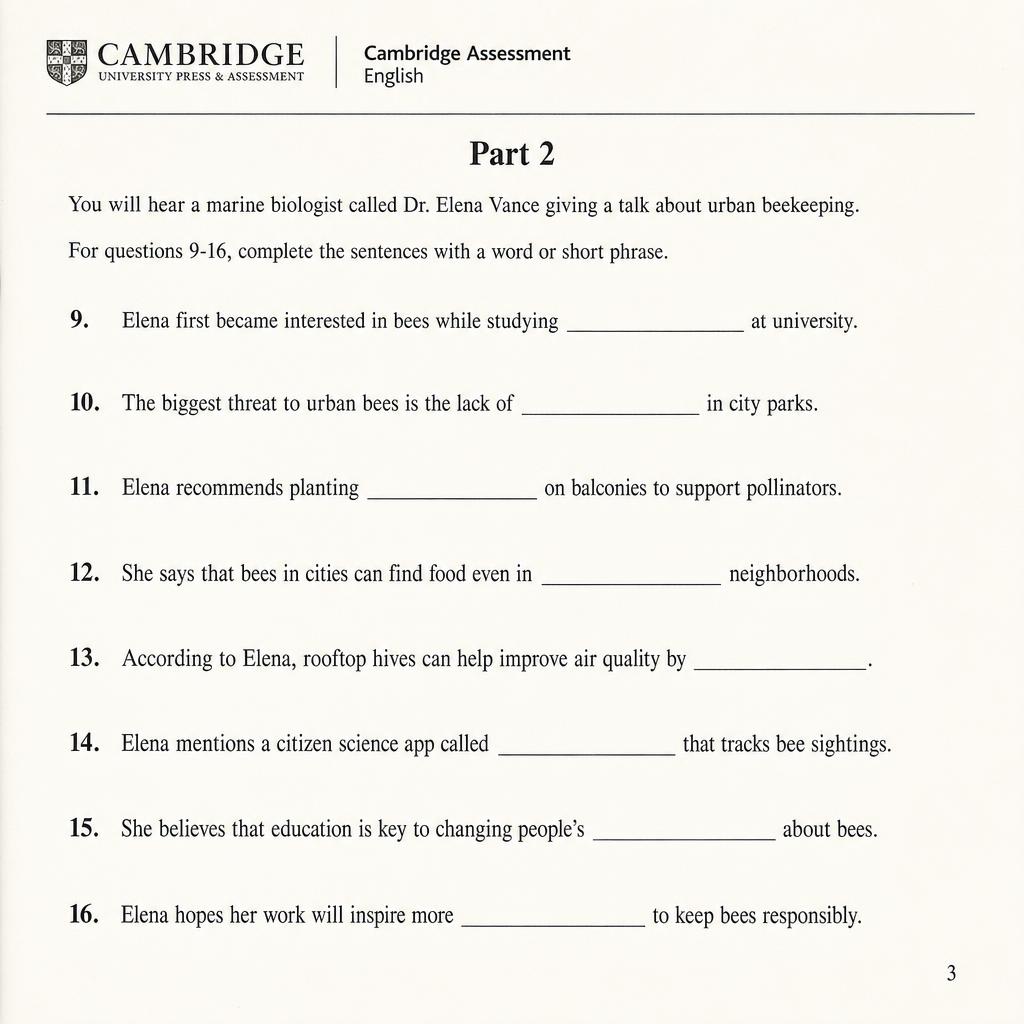
45 seconds of silent preview. For EACH numbered gap (9–16), underline the words on either side and label the missing WORD CLASS: noun, number, name, adjective.
Discuss in pairs
In pairs, predict the class of each gap BEFORE the audio plays. After the audio, justify your answer with the exact wording you heard.
Exam skills · Section 8
3 minCPE Listening Part 2 — Sentence Completion, in depth
Strategy
- 1.PREVIEW for 45 seconds: read every sentence, underline the words around each gap, label the missing WORD CLASS.
- 2.Play 1 = CAPTURE: write something for every gap, even if you're unsure.
- 3.Play 2 = VERIFY: confirm exact wording, fix gaps, check spelling.
- 4.Write the SPEAKER'S exact words — never paraphrase, never translate.
- 5.If you wrote more than 3 words, you've over-written — cut to the core noun phrase.
Example
Printed: 'The biggest threat to urban bees is the lack of ____ in city parks.' Preview label: PLURAL NOUN (a thing bees need). Heard: 'what really endangers urban bees is just how few wildflowers we leave growing'. Write: WILDFLOWERS. NOT 'flowers', NOT 'plants' — the speaker's exact word.
Practice · Section 9
7 minFill in the blank
Question 1.Predict the class: 'The course lasts ____ weeks.' → the gap needs a…
Question 2.Predict the class: 'She works for an organisation called ____.' → the gap needs a…
Question 3.Predict the class: 'The main problem is the lack of ____ in the area.' → the gap needs a…
Question 4.Predict the class: 'They live in a very ____ part of town.' → the gap needs a…
Question 5.Predict the class: 'He started by studying ____ at university.' → the gap needs a…
Question 6.Predict the class: 'She recommends planting ____ on your balcony.' → the gap needs a…
Question 7.Predict the class: 'Her work helps to improve air quality by ____.' → the gap needs a…
Question 8.Predict the class: 'She hopes to inspire more ____ to take up beekeeping.' → the gap needs a…
Q1.From the audio: 'I actually started out studying ____ at university.' (2 words)
Q2.From the audio: 'The biggest threat is the lack of ____ in city parks.' (1 word)
Q3.From the audio: 'I always say: plant ____ on your balcony.' (1 word)
Q4.From the audio: 'A citizen science app called ____.' (1 word)
Writing · Section 10
4 minPut it in writing
Your task
Listen to the Dr. Vance monologue once more. Take rough notes in your own words, then rewrite ONE 80–100 word paragraph summarising her three main points. Then circle EVERY word in your paragraph that would NOT be accepted as a Part 2 answer (because it's a paraphrase, not her exact word).
- • Submit both the audio source and your written summary.
- • Circle every paraphrased word — these are the trap words in Part 2.
- • Add a short note: which of HER exact words would you have written in a Part 2 gap?
Before you submit
- ☐ Paragraph is 80–100 words.
- ☐ Every paraphrased word is circled.
- ☐ At least 5 of HER exact words are listed at the bottom.
- ☐ No invented details — only what she actually said.
Write your answer here
Restoring…0 words
Show model answer
Sample (94 w): 'Dr. Vance argues that urban bees are NOT mainly threatened by pesticides but by [the absence of] wildflowers in over-tidied city parks. She [advises] city dwellers to plant lavender on their balconies and [points out] that even [run-down] industrial neighborhoods can support bees if a single window box is in range. She also [highlights] the BeeWatch app for citizen scientists. Her [strongest] message is that educating children changes adult attitudes — and that [a few minutes] of weekly rooftop beekeeping can make city dwellers part of the solution.' Exact-word picks: wildflowers / lavender / industrial / BeeWatch / attitudes / city dwellers.
Speaking · Section 11
6 minMake it a real conversation
Justify-your-transcription pairs. Student A reads aloud one printed Part 2 sentence with a gap. Student B says (a) the WORD CLASS that must fit, (b) the exact word they heard, and (c) one phrase from the audio that proves it. Swap each round. 7 minutes.
Useful phrases
- The gap has to be a [noun / number / name / adjective] because…
- I heard her say exactly '…' so the answer is…
- It can't be a synonym — Cambridge only accept her exact word.
- The trigger word right before the gap is…
- I almost wrote ____ but that's a paraphrase, not what she said.
- She only said it once — at about [minute] in.
- The class fits but the spelling needs checking…
- Reading the sentence aloud with that word, the cohesion is fine.
- A'I actually started out studying ____ at university.'
- B_______________
- A'The biggest threat is the lack of ____ in city parks.'
- B_______________
- A'I always say: plant ____ on your balcony.'
- B_______________
Your speaking notes
Restoring…Optional · Teacher-led
Teacher Activities
Two extensions for stronger groups or longer sessions. ~22 min total
Homework · Section 12
Take-homeTake it home
Re-listen to the Dr. Vance monologue (or replay the audio in class). Complete the 8 Part 2 gaps from the visual stimulus page. For each one, also write in brackets the WORD CLASS you predicted before listening.
questions · Eight gaps to complete
- 9. Elena first became interested in bees while studying ____ at university.
- 10. The biggest threat to urban bees is the lack of ____ in city parks.
- 11. Elena recommends planting ____ on balconies to support pollinators.
- 12. She says that bees in cities can find food even in ____ neighborhoods.
- 13. According to Elena, rooftop hives can help improve air quality by ____.
- 14. Elena mentions a citizen science app called ____ that tracks bee sightings.
- 15. She believes that education is key to changing people's ____ about bees.
- 16. Elena hopes her work will inspire more ____ to keep bees responsibly.
Finished? Reveal the answer key to self-check your work.
Build a 'paraphrase map' for the 8 answers. For each exact-word answer, write the printed paraphrase and at least ONE other synonym Cambridge would NOT accept. This trains your ear to ignore paraphrases.
vocab list · For each of the 8 answers
- Exact word the speaker said (the only acceptable answer)
- Printed paraphrase wording from the page
- One synonym Cambridge would reject (your trap word)
Finished? Reveal the answer key to self-check your work.
Find a 2–3 minute monologue online (TED-Ed short, BBC Sounds clip, podcast intro). Write your OWN Part 2 page from it: 8 paraphrased sentences with gaps. Then write the answer key with the speaker's EXACT words.
prompts · Include
- The source URL and speaker's name.
- Eight paraphrased printed sentences (numbered 9–16) with one-to-three-word gaps.
- An answer key with the speaker's exact words AND the word class of each gap.
Record yourself (60–90 seconds) walking an imaginary classmate through your preview routine for one Part 2 page. Show them — out loud — how you decide what word class fits each gap BEFORE the audio starts.
prompts · Cover, in this order
- Read one printed sentence aloud.
- Name the words on either side of the gap.
- State the WORD CLASS that must fit and why.
- Predict ONE example word you might hear.
- Warn the listener about the biggest mistake to avoid (paraphrasing).
Recap · Section 13
Wrap-upWhat you've learned
- Part 2 = 8 sentence-completion gaps, 1 mark each (max 8), ONE to THREE words per gap.
- Answers must be the speaker's EXACT words — synonyms and paraphrases are marked wrong.
- You hear the audio TWICE. Play 1 = capture; Play 2 = verify and check spelling.
- The 45-second PREVIEW is the most important phase — label every gap with its word class.
- Trap: the printed sentence is a paraphrase, not a transcript. Listen for the speaker's exact wording, not the printed wording.
Extra Practice
Need more practice with this exam skill?
R&UoE P4 · Key Word Transformations
Part 4 · Key word transformations
Three to eight words, keyword unchanged
Practise this exam skill
Listening P2 · Sentence Completion
Part 2 · Sentence completion
Exact words, grammatical fit, no paraphrase
Practise this exam skill
Listening P1/P3 · Distractors
Distractor awareness drill
Corrections, concessions and false starts that trap careless listeners
Practise this exam skill
Optional — this doesn't count towards lesson completion.