
Module 3 · Word Power · Lesson 09
Word Formation in Depth
Suffixes, prefixes and internal change
Get talking · Section 1
4 minWarm-up
In pairs, you have 60 seconds. From the root DECIDE, write down every other word in the family: noun, verb, adjective, adverb, negative forms. Compare totals.
Which two of these formations are wrong? 'unpossible', 'misunderstand', 'disagree', 'inhonest', 'overreact'. Why do English speakers reject them?
Read aloud: 'Her ANALYSIS was sharp.' / 'She ANALYSED the data.' / 'It was an ANALYTICAL piece.' What changes — meaning, or grammar role?
Grammar focus · Section 2
8 minThe four-form word family
Quick rule
Every C1 root has up to four core forms: noun · verb · adjective · adverb. The gap's grammar tells you which form to write.
Examples
ABLE → 'are BETTER ABLE to survive' (comparative adjective phrase needed).
RESEARCH → 'RESEARCHERS around the world' (plural noun — person).
COMMUNICATE → 'their own way of COMMUNICATION' (noun after 'of').
SURPRISE → 'one of the most SURPRISING findings' (adjective after superlative).
INTENSE → 'remarkably INTENSE' (the original adjective fits, no change).
IMAGINE → 'it is hard to IMAGINE the impact' (verb after 'to').
Quick check
Question 1.ABLE → 'Seedlings connected to mature trees are ____ to survive in harsh conditions.'
Question 2.RESEARCH → 'Over the past few decades, ____ around the world have uncovered remarkable evidence.'
Question 3.COMMUNICATE → 'Forests have their own way of ____.'
Question 4.SURPRISE → 'One of the most ____ findings is that trees transmit chemical signals.'
Question 5.IMAGINE → 'It is hard to ____ the impact our actions may have.'
Quick check 1.What does Part 3 test?
Quick check 2.How many gaps in Part 3?
Vocabulary · Section 3
6 minWords & phrases to own
noun-forming suffix
an ending that turns a word into a noun: -tion, -ment, -ance, -ity, -ness
Use it now
Say one sentence that is true about you using this expression.
adjective-forming suffix
an ending that turns a word into an adjective: -ous, -al, -ive, -able, -ful, -less
Use it now
Say one sentence that is true about you using this expression.
adverb-forming suffix
almost always -ly (added to an adjective)
Use it now
Say one sentence that is true about you using this expression.
negative prefix
un-, in-, im-, dis-, mis- — flips the meaning of the root
Use it now
Say one sentence that is true about you using this expression.
intensifying prefix
over-, under-, re-, mis- — modifies degree or repetition, not polarity
Use it now
Say one sentence that is true about you using this expression.
internal change
the root itself changes form: long → length, deep → depth, high → height
Use it now
Say one sentence that is true about you using this expression.
word family
all the related words built from one root: decide / decision / decisive / decisively
Use it now
Say one sentence that is true about you using this expression.
stress shift
the stressed syllable moves when a suffix is added: PHOto → phoTOgraphy
Use it now
Say one sentence that is true about you using this expression.
Tap an item on the left, then tap its match on the right.
Pronunciation · Section 4
3 minStress shift across the word family
When you add certain suffixes, the stress on the root moves. This matters in speaking AND in spelling — a wrong stress often produces a wrong vowel. Drill the whole family aloud, not the words in isolation.
- PHOto → phoTOgraphy → photoGRAPHic
- ANalyse → aNALysis → anaLYTical → anaLYTically
- ECOnomy → ecoNOMic → ecoNOMically
- BIology → bioLOGical → bioLOGically
- deCIDE → deCIsion → deCIsive → deCIsively (stress stays put)
Reading · Section 5
8 minWhy English keeps growing
English borrows, blends and builds. According to the Oxford English Dictionary, around 1,000 new words enter active use every year — and the vast majority are not invented from nothing. They are FORMED from words English already has, using a small kit of prefixes, suffixes and internal sound changes that have been remarkably stable for centuries. This matters for the C1 candidate because it means most 'new' words aren't really new at all. If you know the noun 'access', you already half-know the verb 'to access', the adjective 'accessible', the noun 'accessibility' and the negative 'inaccessibility'. Five words for the price of one — but only if you store them together as a family. The candidate who learns 'access' as a single item has 20% of what the candidate who learns the whole family has. This is precisely what Part 3 of the Reading and Use of English paper tests. You're given a root in capitals — ABLE, COMMUNICATE, SURPRISE — and a sentence with a gap. The exam isn't asking 'do you know this word?'. You clearly do; it's printed in capitals right next to the gap. It's asking 'do you know its family?'. Can you take ABLE and produce 'better able' when the grammar needs a comparative? Can you take COMMUNICATE and produce 'communication' when the grammar needs a noun after 'of'? That's depth, not breadth. A few patterns will earn you most of your marks. Verbs become nouns through -tion (communicate → communication), -ment (develop → development) and -ance (perform → performance). Adjectives become nouns through -ity (able → ability) and -ness (kind → kindness). Nouns and verbs become adjectives through -ous (danger → dangerous), -al (nation → national), -ive (act → active) and -able (read → readable). Almost any adjective becomes an adverb by adding -ly. Watch out for the internal-change traps that defeat the patterns: long → length (not 'longness'), high → height (not 'highness'), deep → depth (not 'deepness'). These pairs must be memorised.
Question 1.According to the writer, what does Part 3 actually test?
Question 2.Roughly how many new words enter active English each year, according to the OED?
Question 3.Why is 'longness' not a real English word?
Question 4.What's the most reliable way to add vocabulary at C2, according to the text?
Q1.Most 'new' English words are invented from scratch.
Q2.Storing words as families gives you more lexis per unit of study.
Q3.Part 3 tests whether you recognise the root, not whether you can transform it.
Q4.Internal-change pairs (long → length) follow the standard suffix rules.
Listening · Section 6
8 minDr. Amelia Hartley: 'How English builds new words'
Listening audio
Tap play to listen. Scrub the bar or use ± 5 s to jump.
Show transcript
Tom (m):Welcome back. I'm joined this morning by Dr. Amelia Hartley, senior lexicographer at the Oxford English Dictionary. Amelia, you've spent twenty years tracking how new words enter the language. What surprises you most?
Dr. Amelia Hartley (f):Honestly, Tom, what surprises me most is how PREDICTABLE it all is. People imagine new words appear out of nowhere, but ninety percent of them follow patterns that have been in English for, oh, eight hundred years. We're still using the same prefixes and suffixes the medieval scribes used.
Tom (m):Give us an example. How would a word like 'doomscroll' actually enter the dictionary?
Dr. Amelia Hartley (f):Right. 'Doomscroll' is a compound — 'doom' plus 'scroll' — and the moment people start using it as a verb, you immediately get the family forming: 'doomscroller', the noun for the person; 'doomscrolling', the activity; even an adjective, 'doomscrollable', meaning content designed to keep you scrolling. The family builds itself in a matter of months.
Tom (m):And for language learners — how does this help someone preparing for, say, an advanced English exam?
Dr. Amelia Hartley (f):Oh, enormously. My advice is always the same: never learn a word alone. Always learn it with its family. If you meet the verb 'communicate', you note down the noun 'communication', the adjective 'communicative', the adverb 'communicatively'. Four words, one notebook entry. That is genuinely the fastest way to build C2-level vocabulary.
Tom (m):What about the words that BREAK the patterns? The traps?
Dr. Amelia Hartley (f):Ah, those are the joy of English. 'Long' should become 'longness' — but it doesn't. It becomes 'length'. 'Deep' becomes 'depth', 'high' becomes 'height', 'wide' becomes 'width'. These are old Germanic survivals, and they're the ones that catch learners out. You simply have to memorise them as pairs.
Tom (m):Last question, Amelia. If a student has only ten minutes a day to work on vocabulary, what should they actually do?
Dr. Amelia Hartley (f):Take one word — just one — and write its full family before bed. Noun, verb, adjective, adverb, negative form. Ten minutes, one root, the whole family. Do that for a hundred days and you've added four hundred active C1 words to your range. That is a genuinely transformative habit.
Question 1.According to Dr. Hartley, what is most SURPRISING about how new words enter English?
Question 2.Which example does she use to show a new word's family forming?
Question 3.What is her core advice for an advanced learner?
Question 4.Why does she call 'length' a TRAP?
Question 5.How many minutes a day does she recommend on word families?
Question 1.Dr. Hartley's central argument is best summarised as…
Visual stimulus · Section 7
3 minA real Part 3 page
60 seconds of silent preview. For EACH gap (17–24), read the sentence around the gap, identify the WORD CLASS needed (noun / verb / adjective / adverb), then form it from the capitalised root.
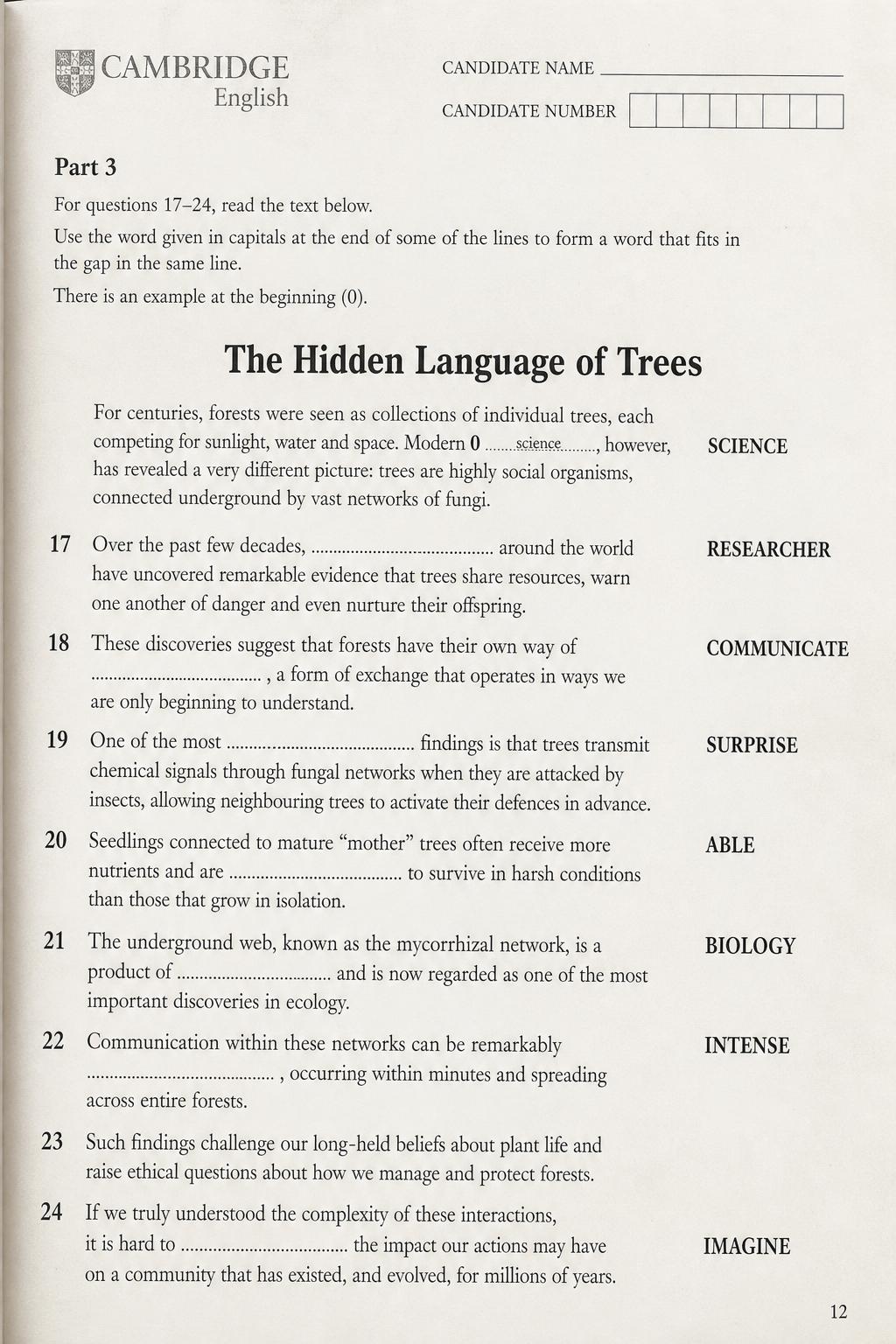
Discuss in pairs
In pairs, decide the word class of each gap BEFORE filling it. Justify your choice from the surrounding grammar.
Exam skills · Section 8
3 minCPE R&UoE Part 3 — Word Formation, in depth
Strategy
- 1.READ the whole text for gist (30 seconds) — context decides form.
- 2.FOR EACH GAP: cover the root, read the sentence, decide the WORD CLASS needed (noun / verb / adjective / adverb).
- 3.FORM the root in that class — including any prefix the meaning needs (negative, repetition, degree).
- 4.Check NUMBER (singular/plural) and TENSE (present/past) before moving on.
- 5.Sometimes the original word fits — don't transform for the sake of it.
Example
Root: ABLE. Sentence: 'Seedlings are ____ to survive in harsh conditions.' Word class needed: adjective (after 'are', describing the seedlings). Form: 'better able' (the comparative adjective phrase the meaning calls for). Spelling: a-b-l-e.
Practice · Section 9
7 minFill in the blank
Question 1.DECIDE → 'She made a quick ____ to apply.'
Question 2.COMMUNICATE → 'The team has excellent ____ skills.'
Question 3.ABLE → 'I admire her ____ to stay calm under pressure.'
Question 4.SURPRISE → '____ , he agreed without arguing.'
Question 5.BIOLOGY → 'There is a ____ explanation for the behaviour.'
Question 6.IMAGINE → 'The novel shows real ____.'
Question 7.INTENSE → 'The training ____ over the final week.'
Question 8.RESEARCH → 'They are still ____ the causes of the disease.'
Q1.Form a noun from ABLE that means 'the quality of being able'.
Q2.Form an adverb from SURPRISE.
Q3.Form a noun from LONG (the internal-change noun — NOT 'longness').
Q4.Form the negative adjective from POSSIBLE (with prefix).
Q5.Form a noun from HIGH (internal change).
Writing · Section 10
4 minPut it in writing
Your task
Pick ANY five words from this lesson. For each one, write its full four-form family (noun · verb · adjective · adverb), mark stress on each form, and add ONE example sentence using each. Total: ~20 family members, ~20 example sentences.
- • Use only words you genuinely want to add to your active range — no padding.
- • Mark stress with CAPS on the stressed syllable: phoTOgraphy.
- • If a form doesn't exist (e.g. no adverb), write 'none' — don't invent it.
Before you submit
- ☐ Five different roots chosen.
- ☐ Each root has its full available family listed.
- ☐ Stress is marked on every form.
- ☐ Each form has an example sentence (NOT just a definition).
Write your answer here
Restoring…0 words
Show model answer
Sample for DECIDE: deCIDE (v) — 'I decided to apply.' / deCIsion (n) — 'It was a tough decision.' / deCIsive (adj) — 'She was decisive in the meeting.' / deCIsively (adv) — 'They acted decisively.' / negative: inDEcisive (adj) — 'He's quite indecisive when tired.' Full family logged, stress marked, five live sentences.
Speaking · Section 11
6 minMake it a real conversation
Defend-the-form pairs. Student A reads aloud a sentence with a gap and a root in capitals. Student B says (a) the WORD CLASS the gap needs, (b) the form of the root, and (c) one reason from the surrounding grammar that proves the class. Swap each round. 6 minutes.
Useful phrases
- The gap needs a [noun / verb / adjective / adverb] because…
- The word before the gap is 'of' / 'are' / 'most' — that points to a…
- From ROOT, the form has to be…
- I also need a negative prefix here because…
- It's plural because the verb is plural.
- The original word fits — no transformation needed.
- Watch out, this is an internal-change pair — not the regular -ness form.
- The stress shifts when we add this suffix — let me say it again.
- ACOMMUNICATE → 'Forests have their own way of ____.'
- B_______________
- ASURPRISE → 'One of the most ____ findings is that trees share resources.'
- B_______________
- AABLE → 'Connected seedlings are ____ to survive harsh conditions.'
- B_______________
Your speaking notes
Restoring…Optional · Teacher-led
Teacher Activities
Two extensions for stronger groups or longer sessions. ~22 min total
Homework · Section 12
Take-homeTake it home
Complete the 8 Part 3 gaps from the visual stimulus page ('The Hidden Language of Trees'). For each one, also write in brackets the WORD CLASS you identified before forming the word.
questions · Eight gaps to complete
- 17. Over the past few decades, ____ around the world have uncovered remarkable evidence. (RESEARCHER)
- 18. These discoveries suggest that forests have their own way of ____ . (COMMUNICATE)
- 19. One of the most ____ findings is that trees transmit chemical signals. (SURPRISE)
- 20. Seedlings connected to mature trees are ____ to survive in harsh conditions. (ABLE)
- 21. The underground web is a product of ____ co-evolution. (BIOLOGY)
- 22. Communication within these networks can be remarkably ____ . (INTENSE)
- 23. Such findings challenge our long-held beliefs about plant life. (no transformation — example/control)
- 24. It is hard to ____ the impact our actions may have. (IMAGINE)
Finished? Reveal the answer key to self-check your work.
Build a 'family map' notebook page. Pick 10 C1 roots from your own course materials. For each root, log its four-form family (noun / verb / adjective / adverb) PLUS its main negative form. Mark stress on every form. Aim for 40+ active words on one page.
vocab list · Suggested roots to start (pick any 10)
- ANALYSE, CRITIC, ECONOMY, ENVIRONMENT, GLOBAL, IDENTITY, INTERPRET, JUSTICE, NATURE, POLITIC, SCIENCE, SIGNIFY, SOCIETY, TECHNOLOGY, UNIVERSE
Finished? Reveal the answer key to self-check your work.
Find a short article online (~500 words). Pick 5 nouns and rewrite each one as a sentence using a DIFFERENT word-class form of the same root. (e.g. find the noun 'decision' → rewrite using the verb 'decide' or the adjective 'decisive'.)
prompts · For each of 5 nouns
- Copy the original sentence (with the noun in bold).
- Identify the root word.
- Rewrite the sentence using a different form of that root — keeping the meaning.
- State which form you used (noun / verb / adjective / adverb).
Record yourself (60–90 seconds) walking through ONE Part 3 gap from start to finish. Show — out loud — how you identify the word class, decide the form, and check for prefix / number / spelling before writing.
prompts · Cover, in this order
- Read the sentence aloud and name the root in capitals.
- Identify the WORD CLASS the gap needs and the grammar reason.
- Form the root in that class.
- Check whether a prefix is needed for meaning.
- Check number (singular/plural) and tense.
- Say the final word with correct stress.
Recap · Section 13
Wrap-upWhat you've learned
- Part 3 tests vocabulary DEPTH — how many forms of one root you can produce — not breadth.
- Every C1 root has up to four core forms: noun · verb · adjective · adverb. Store them together.
- The gap's surrounding grammar tells you which WORD CLASS to write. Identify the class FIRST, the form second.
- Use the suffix kit: noun (-tion / -ment / -ity / -ness), adjective (-ous / -al / -ive / -able), verb (-ise / -ify / -en), adverb (-ly).
- Watch the traps: prefix for meaning (im-, un-, dis-) and internal change (long → length, deep → depth).
Extra Practice
Need more practice with this exam skill?
R&UoE P1 · Multiple Choice Cloze
Part 1 · Multiple-choice cloze
Collocation, fixed phrases and shades of meaning
Practise this exam skill
Writing P1 · Essay
Part 1 · Essay language & planning
Summarising two texts, evaluating, and building a controlled argument (240–280 words)
Practise this exam skill
Optional — this doesn't count towards lesson completion.